
the new tools of craft
For much of the last century, architecture appeared to be moving steadily away from craft. Industrial production favored repetition over variation, efficiency over ornament, and standardization over local expression. As buildings became increasingly assembled from catalogs of prefabricated components, the figure of the artisan seemed to fade from the architectural imagination.
Then came the digital revolution. Early computational design opened up entirely new formal possibilities, allowing architects to generate increasingly complex geometries on screen. As digital tools evolved, attention shifted toward finding new ways to translate those geometries into physical structures, reconnecting design with materials, fabrication, and construction.
Today, however, a new generation of architects, designers, researchers, and fabricators is rewriting that narrative. Across workshops, fabrication labs, universities, and construction sites, digital tools are being used to expand craftsmanship. From BIG’s robotic timber carving experiments in Venice to Studio RAP’s algorithmically generated ceramics in Amsterdam, from The New Raw’s woven structures printed from recycled plastic to the robotic construction research of ETH Zurich, digital tools are increasingly being used to expand craftsmanship. Robotics, computational design, CNC fabrication, and large-scale 3D printing are emerging as new instruments of craftsmanship, expanding how architects and makers design, fabricate, and build.
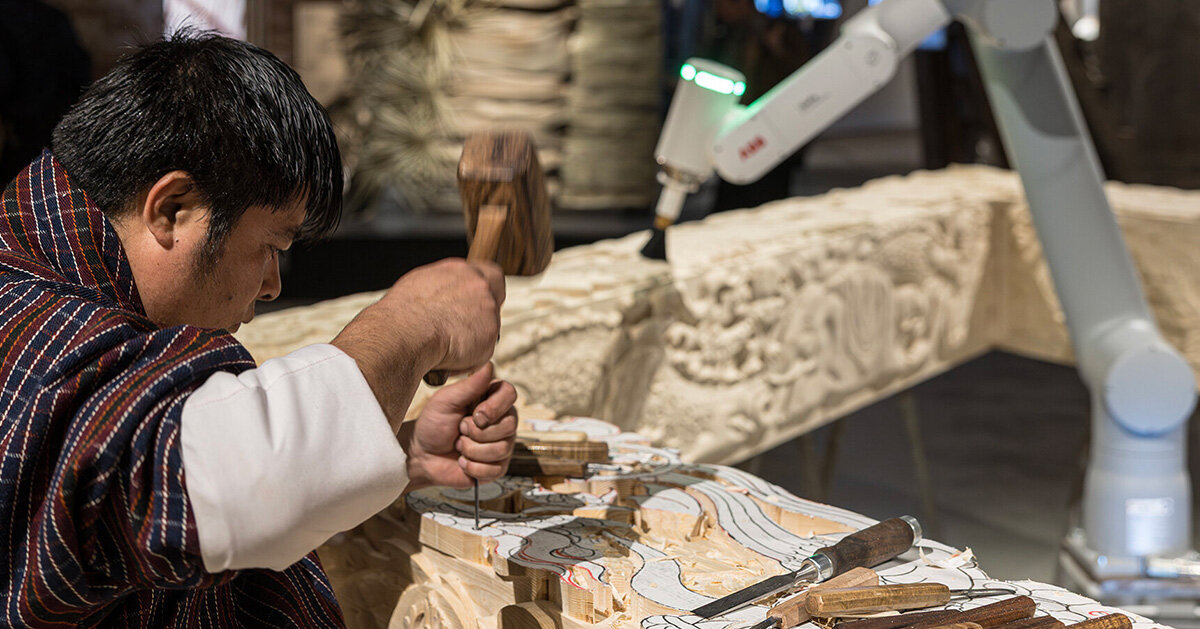
Ancient Future: Bridging Bhutan’s Tradition and Innovation (read more here) | image courtesy of BIG
from hand to robot and back again
Few projects illustrate this shift more clearly than Ancient Future: Bridging Bhutan’s Tradition and Innovation, presented by Bjarke Ingels Group (BIG) at the Venice Architecture Biennale 2025. Installed within the Arsenale, the exhibition centered on a deceptively simple question: what happens when traditional craftsmanship and machine intelligence work together?
In the exhibition, Bhutanese artisans carved intricate motifs into timber beams while a robotic milling arm simultaneously reproduced the same patterns through digital fabrication. The resulting pieces formed part of a full-scale prototype for the future Gelephu International Airport, one of the flagship projects within Bhutan’s Gelephu Mindfulness City masterplan.
Visitors could compare in real time the subtle irregularities of the hand-carved surfaces with the precision of robotic production. Yet the installation deliberately avoided framing the relationship as a competition, proposing, instead, a new model of collaboration where technology acts as an extension of human knowledge.
As BIG partner Giulia Frittoli noted, machine intelligence allows craft to scale while keeping artistry rooted in human hands. The project suggests that the future of making may not lie in choosing between heritage and innovation, but in allowing them to evolve together.
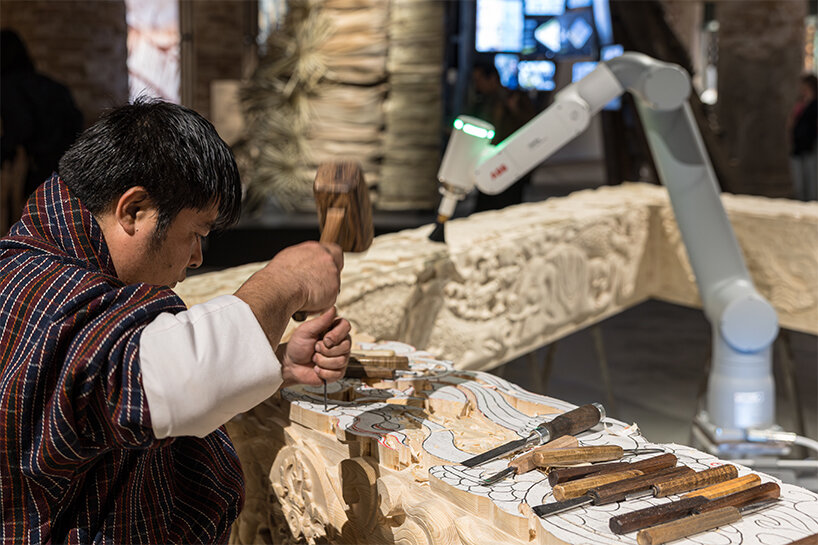
combining ancestral woodcraft with robotic precision | image courtesy of BIG
the return of architectural ornament
For decades, ornament occupied an uneasy position within architectural discourse. Modernism largely dismissed decorative detail as unnecessary, expensive, or even regressive. Intricate facades and bespoke craftsmanship became difficult to justify within an industry driven by industrial efficiency. Digital fabrication is changing that equation.
In Rotterdam, Studio RAP has built its practice around the belief that computation can restore complexity and
individuality to architecture. Operating from the RDM Innovation Dock, the multidisciplinary studio combines computational design, robotic fabrication, material research, and traditional references to create highly expressive architectural surfaces.
Their Ceramic House project in Amsterdam demonstrates how this approach can transform contemporary architecture. Located along the historic P.C. Hooftstraat, the facade of the building consists of hundreds of unique 3D printed ceramic elements generated through custom algorithms and finished through artisanal glazing processes.
Studio RAP translates cultural references into entirely new architectural languages. Textile traditions, ceramic heritage, natural formations, and historical narratives are encoded into computational workflows that generate forms impossible to draw manually and prohibitively expensive to produce through conventional means.
The process often begins with hand sketches. These sketches are then interpreted through custom software, transforming analog ideas into buildable geometries that robotic systems can fabricate, resulting in a form of digital craftsmanship where code functions as a new medium through which creativity can operate.
This philosophy is visible throughout the studio’s work, from Ceramic House to New Delft Blue and the monumental Blue Voyage installation in Dubai, where nearly 900 robotically printed ceramic tiles create flowing surfaces inspired by the movement of water.
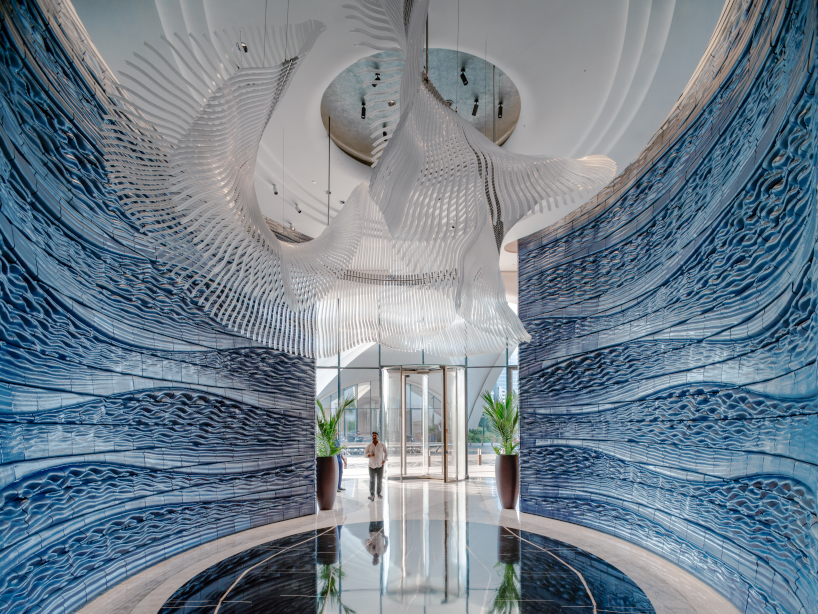
Blue Voyage by Studio RAP (read more here) | image by Riccardo De Vecchi
complexity becomes affordable
The revival of ornament is not limited to ceramics. Some of the most radical explorations of digital craft are emerging from architects who treat algorithms as creative tools. Michael Hansmeyer’s projects demonstrate how computational processes can generate levels of complexity previously unimaginable in architecture. Instead of manually designing every surface, Hansmeyer develops recursive algorithms that continuously subdivide geometry, producing millions of intricate details. The resulting spaces resemble a collision between natural formations, gothic cathedrals, baroque interiors, and artificial intelligence. Yet they are entirely new forms of ornament made possible through digital fabrication.
Digital Grotesque, one of the first fully enclosed architectural spaces created through large-scale sandstone 3D printing, demonstrated that computational complexity no longer carries the economic penalties associated with traditional craftsmanship.
This is perhaps one of the most transformative consequences of digital fabrication. For centuries, elaborate ornament required immense amounts of labor. Today, once a computational process has been developed, producing a highly intricate component can cost little more than producing a simple one. The economic logic that once pushed architecture toward simplification is beginning to shift.
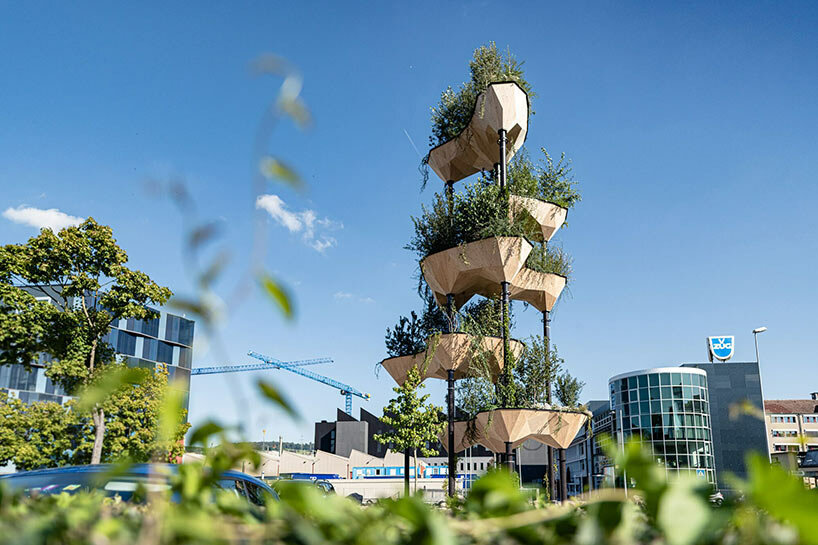
Hansmeyer’s more recent Tor Alva in the Swiss Alps, currently recognized as the world’s tallest 3D printed concrete tower, pushes this idea even further. Its intricate columns and highly articulated surfaces suggest a future in which ornament, structure, and fabrication become inseparable.
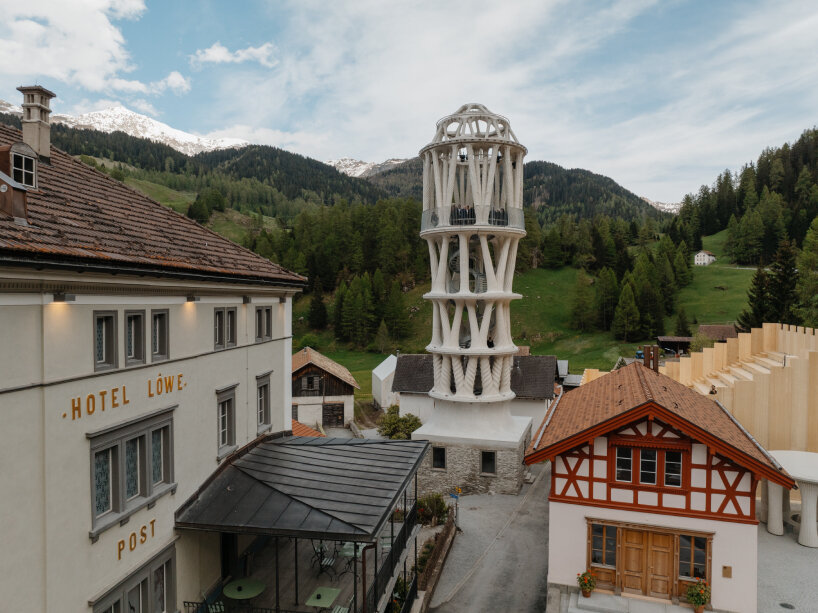
Tor Alva (read more here) | image courtesy of Michael Hansmeyer and Benjamin Dillenburger, photo by Birdviewpicture
learning from materials
At ETH Zurich, Gramazio Kohler Research has spent nearly two decades investigating how robotics can transform construction by embedding material intelligence directly into the design process.
Their pioneering Gantenbein Vineyard facade demonstrated how industrial robots could assemble thousands of bricks into a richly textured surface that filters light while expressing structural logic. The facade appears almost woven, transforming a familiar material into something unexpectedly dynamic.
The group’s research later expanded into the DFAB House project, a landmark experiment in digitally fabricated architecture. Completed in Switzerland in 2019, the building combined robotic construction, computational design, automated timber assembly, and 3D printed formwork into a single architectural system.
A similar approach can be found at the University of Stuttgart’s ICD and ITKE research programs. Their experimental pavilions draw inspiration from biological systems such as shells, fibers, and plant structures, translating natural construction logics into robotic fabrication processes. The resulting structures often appear impossibly light, consisting of precisely wound fibers or ultra-thin timber assemblies that achieve remarkable structural performance with minimal material use.
These projects reveal a profound shift in architectural thinking. Material behavior is increasingly becoming an active participant in the design process, informing form, structure, and fabrication from the outset. In this sense, contemporary digital fabrication reconnects architecture with one of the oldest principles of craftsmanship: a deep understanding of materials and their inherent possibilities.
Semiramis by ETH Zurich and Gramazio Kohler Research (read more here) | images courtesy Gramazio Kohler Research
a new vernacular of waste
If traditional craftsmanship was often rooted in local materials, today’s designers face a very different material landscape. One of the most abundant resources available to contemporary cities is not timber, stone, or clay, but waste.
The Rotterdam-based studio The New Raw has built an entire practice around this reality. Founded by Panos Sakkas and Foteini Setaki, the studio develops robotic manufacturing systems that transform discarded plastic into furniture, public infrastructure, architectural installations, and urban interventions. Their work demonstrates how digital fabrication can establish new relationships between communities, materials, and production.
Projects such as Print Your City invited residents to participate directly in the transformation of plastic waste into public furniture, creating a tangible connection between consumption and urban space. Central to the philosophy of the studio is the idea that recycled plastic should not imitate other materials, but develop its own identity. ‘We try not to hide, but to actually reveal the way things are made. You can see and trace the lines of 3D printing, following the path of the material as it forms objects,’ the studio tells designboom. Much like the marks left by a chisel or carving tool, the printed layers become a record of the object’s making, transforming robotic fabrication into a contemporary form of craft expression.
The New Raw frequently describes plastic as a new type of stone, as a material that’s durable, adaptable, and capable of lasting for generations. This dialogue between old and new became particularly evident in Digitally Woven, developed with British designer Gareth Neal. Drawing inspiration from basket weaving, knitting, and traditional craft techniques, the project uses robotic 3D printing to create open lattice structures that resemble handmade textiles.
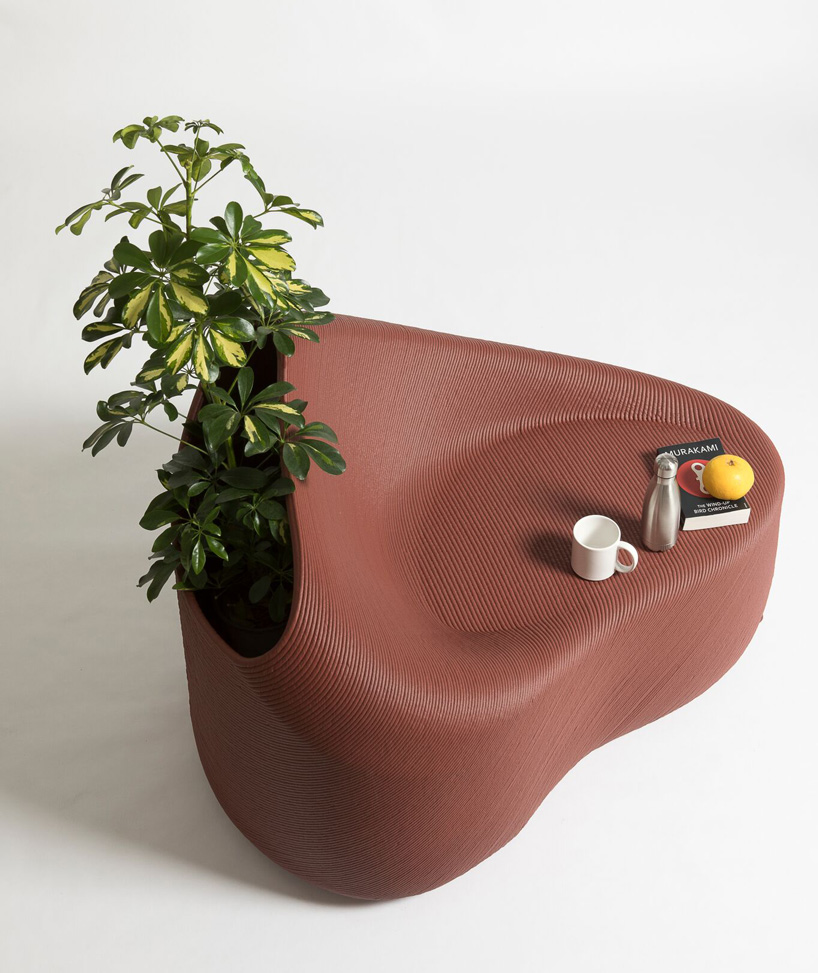
Street furniture by The New Raw, result of Print Your City initiative (read more here) | image © Stefanos Tsakiris
beyond the machine
What unites these projects is not a fascination with technology itself. In fact, many of the most influential practitioners working in digital fabrication are surprisingly skeptical of purely technological narratives. They view robots, algorithms, and printers not as ends in themselves, but as tools that allow architecture to recover qualities that industrial production often suppressed. The same technologies once associated with standardization are increasingly being used to produce buildings, objects, and spaces that are more responsive to place, material, and context. Digital fabrication allows architects to work with difference rather than sameness, creating forms of expression that would have been difficult to achieve through conventional industrial processes. Perhaps the most unexpected outcome of the digital age is that it has created conditions for the return of qualities many believed had been lost.
Across Bhutan, Rotterdam, Zurich, Stuttgart, Amsterdam, and beyond, architects are demonstrating that technological innovation and craftsmanship are not opposing forces, but, in fact, they are increasingly intertwined. The robotic arm becomes a collaborator, the algorithm becomes a design tool, and the fabrication file becomes a contemporary form of craft knowledge passed between disciplines and generations.
The tools may be different, but the ambition to understand materials, to shape them with care, and to create architecture that bears the imprint of human imagination, even when that imagination is expressed through code, remains familiar.
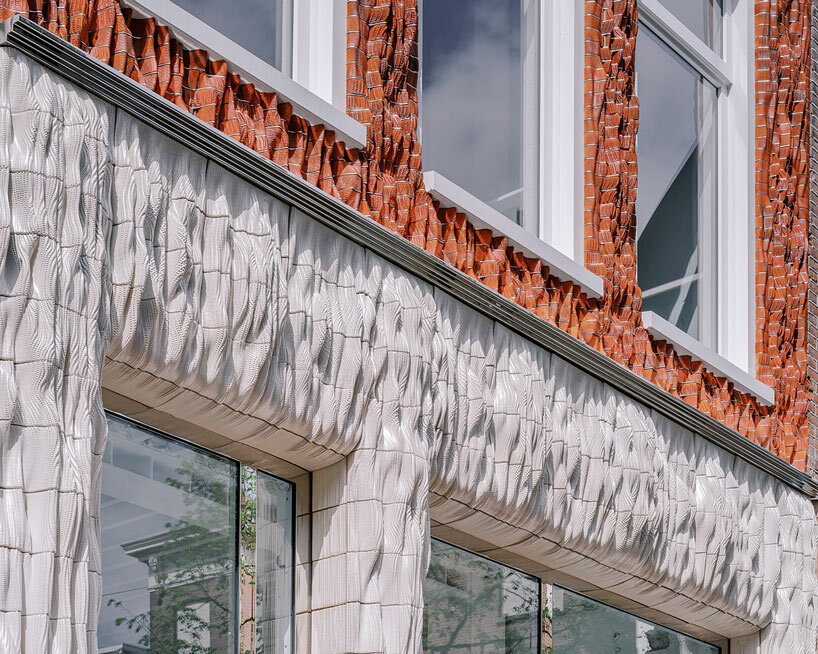
Studio RAP’s Ceramic House (read more here) | image © Riccardo De Vecchi
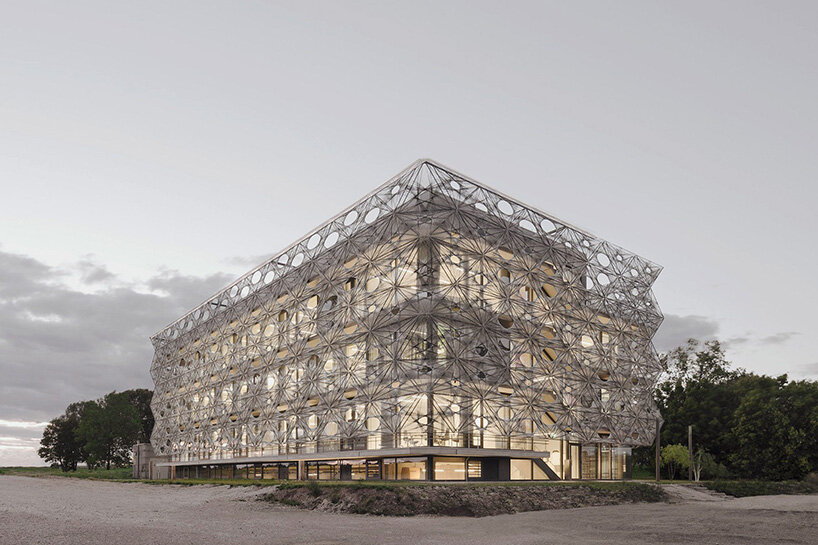
Texoversum, facade by ICD / ITKE research teams (read more here) | image © Brigida González
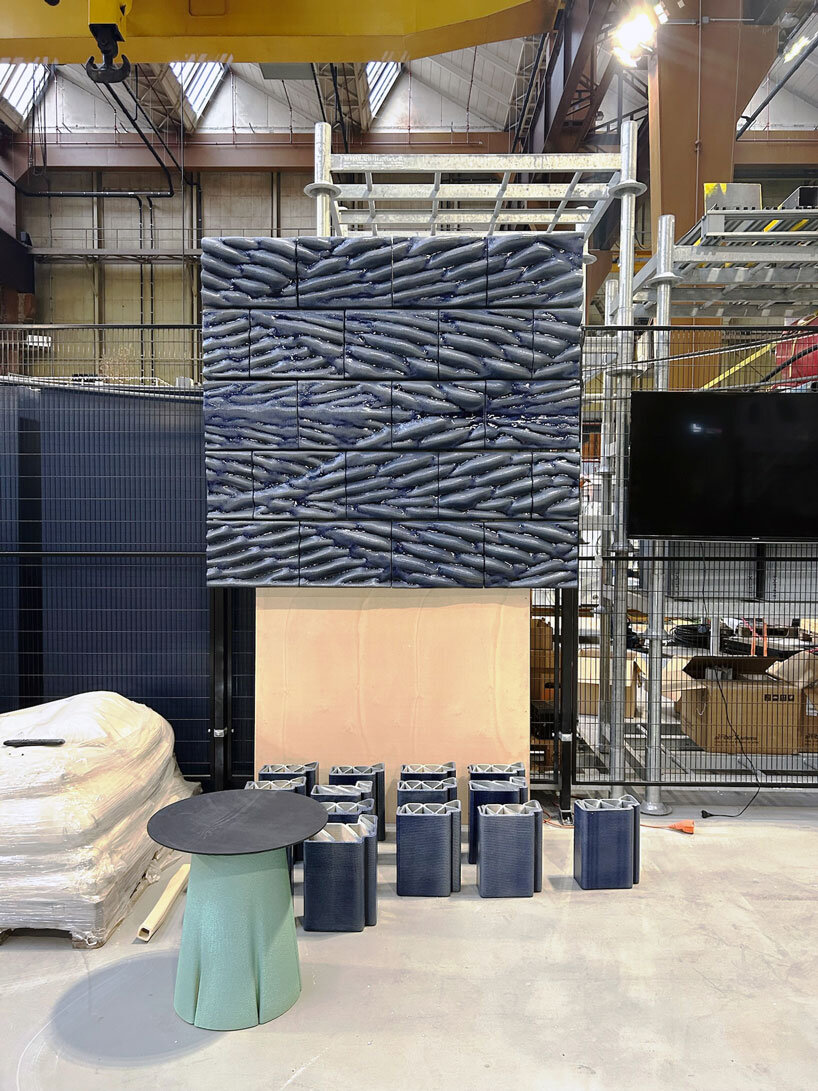
inside Studio RAP’s workspace (read more here) | image © designboom