
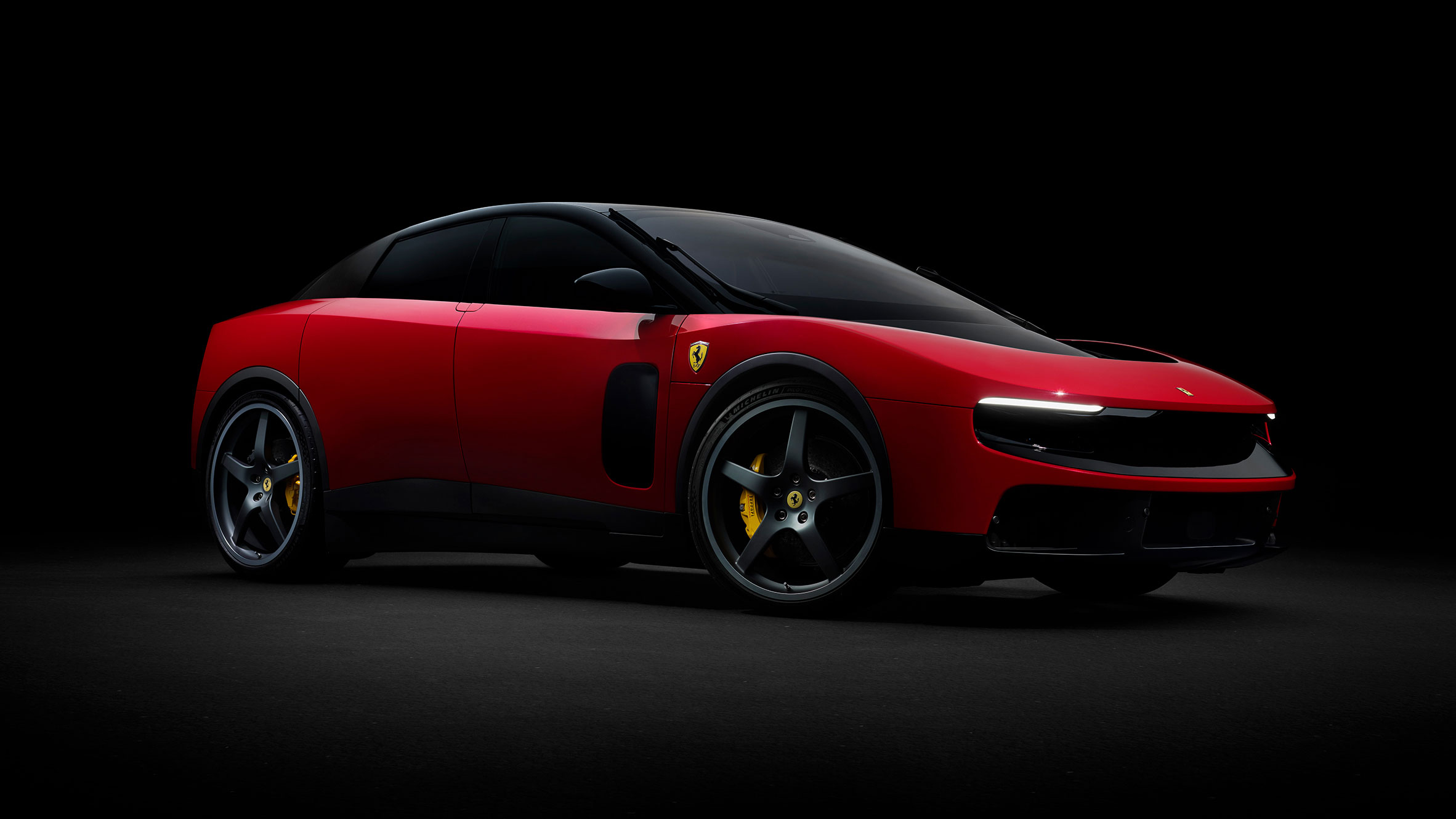
Ferrari has launched its first electric car, the Ferrari Luce, a large sports car designed by Jony Ive and Marc Newson’s studio LoveFrom.
Unveiled today in Rome, Italy, the Ferrari Luce features a spacious, five-seater cabin enclosed in a large curvaceous glasshouse – the upper portion of the vehicle that includes the windscreen, side windows, rear window and a panoramic glass roof.
This is paired with aluminium body panels at the sides that transition into wide aerodynamic wings at the front and rear of the car to create the impression of a single teardrop form wrapped in a coloured metal shell.
“We intellectually separate the passenger cell, the glasshouse as you’d call it,” Australian industrial designer Newson told Dezeen.
“It’s surrounded by this aluminium shell, which is effectively the bodywork.”
“This enables you to preserve this very pure internal form. The two don’t necessarily interrupt each other; they coexist. One exists around the other.”

The design partially came from a desire to minimise aerodynamic drag in order to maximise range from the car’s 122-kilowatt-hour, 800-volt battery.
At the front of the vehicle, the glasshouse extends below the beltline, with the windscreen transitioning into a glossy black aluminium panel that, with no combustion engine in the way, slopes down steeply to form a wedge-like nose.
“Aero is everything when it comes to designing an EV”
Instead of a traditional bonnet, a large aerodynamic wing housing the car’s daytime running lights raises the height of the front of the car to create a more traditional silhouette while efficiently directing airflow up and over the smooth, convex body of the glasshouse to a smaller wing at the rear.

This, combined with vents in the wheel arches and an extremely flat underfloor, results in a drag coefficient – the measure of how efficiently the car moves through the air – of just 0.254, by far the lowest of any car in Ferrari’s history.
“Aero is everything when it comes to designing an EV,” Newson said. “That became clear very, very early on in the process. Drag coefficient is really critically important.”
Ferrari claims the car can travel up to 530 kilometres on a single charge, although this is yet to be officially verified.

That will only be achievable when fitted with the aerodynamically optimised wheels, which are milled from a single piece of aluminium and designed to resemble turbines.
A more traditional but less aerodynamically efficient five-spoke design can also be specified.
Top speed of 310 kilometres an hour
Both wheel options have a diameter of 24 inches (610 millimetres) at the rear and 23 inches (584 millimetres) at the front, giving the car a slight forward rake.
The active suspension will lower the front wheels by 10 millimetres when cruising to further lower the front end to reduce drag.
With a top speed of 310 kilometres an hour, downforce was also a key consideration in the design. According to Ferrari, the Luce achieves similar amounts of downforce as the brand’s Roma and Amalfi models, despite generating around 25 per cent less drag.

The highly aerodynamic form impacted a number of other design decisions. Without a cowl, which is usually found between the windscreen and the bonnet on a car, the Luce’s large windscreen wipers are positioned vertically along the sides of the windscreen to minimise disruption to airflow.
“We wanted to create a continuous windscreen all the way that went to the front of the car, this really long continuous surface,” Newson said.
“You don’t really see that [on any other cars]. You may have seen it on some concept cars from the sixties, but it certainly doesn’t exist out there in the real world.”
The Luce is Ferrari’s first purely electric vehicle (EV).
It is the result of a close collaboration over five years between LoveFrom, the collaborative studio founded by Newson and former Apple design boss Ive, and the Italian carmaker’s in-house design and engineering teams.
Car’s development resulted in 60 new patents for Ferrari
Ferrari developed all of the main components in the car at its base in Maranello, Italy, resulting in over 60 new patents.

While the battery cells are manufactured by the South Korean company SK, the battery modules were developed by Ferrari to be future-proof.
In theory, completely different battery cells could be used within them, reducing the risk of obsolescence as battery technology advances.
Ferrari claims it has already done something similar with the batteries in its hybrid cars, the LaFerrari and F80. Released in 2013 and 2024, respectively, the more advanced battery technology found in the newer car can be used in the older model if it requires a battery change.

Ferrari has been teasing the unveiling of the Luce for some time. In an unusual move for a carmaker, it revealed details of the car’s interior design back in February while keeping the exterior design a closely guarded secret until now.
Also designed with LoveFrom, the interior of the car eschews the large touch screens found in many electric cars in favour of mechanical buttons, dials and switches made from tactile materials such as glass and anodised aluminium.
“We really wanted to do everything, to make sure that everything felt completely in sync”
Ventilation can be turned on or off by rotating the aluminium gaspers by hand.
While the instrument cluster in the cockpit is digital, the display is comprised of two OLED panels layered on top of each other with physical needles sandwiched in between.

This results in an intuitive merging of digital and physical interfaces.
At the click of a button, the clock in the central display can change from a clock to a stopwatch to a compass, with the OLED display changing the dial while mechanical motors change the behaviour of the hands according to the selected function.
For Newson, it was imperative that LoveFrom was involved in both the exterior and interior design of the car.
“What was really, really critical for us was that we created an absolutely coherent experience, both inside and out, so you didn’t have a sense that anything on the interior was shoehorned in, or was conceived by somebody else with different design aesthetics or different values or different objectives,” he said.

“We really wanted – and I think it was the entire point of the exercise – to do everything, to touch everything, to make sure that everything felt completely in sync, both inside and out, all the way through to the user interface,” he added.
“Coherence was just so, so important for us.”
The first five-seat Ferrari
As well as being Ferrari’s first EV, the Luce is also the first Ferrari with five seats, an indication of its ambition to expand beyond the two-seat sports cars it is known for by adding more practical and family-friendly vehicles to its lineup.

According to Newson, the latter, not the former, was the starting point of the project.
The choice to adopt an electric powertrain was then the logical one to free up more internal space for passengers, he claimed.
“This didn’t start life as an EV, Ferrari didn’t come to us and say, ‘We’ve got the EV platform, and we want to populate it’,” he said.
“It was very much a case of setting a bunch of objectives, for example, four doors, five seats, significant things like that, and we decided collectively using an EV platform would afford us the best opportunity to tick a lot of those boxes.”

The final car looks very distinct from other electric cars on the market. And while there are nods to Ferrari’s heritage in the design, such as the distinctive circular tail lights, it also stands out from Ferrari’s combustion-engined and hybrid models.
“Our intention wasn’t to be retrospective or retro in any way,” Newson said.
“I mean, we’re huge fans of Ferrari, and we’re really intimately aware of the history of the brand as well,” he added.
“The result is an equal mix of expertise and confidence in what we do, but also the fact that we’re working with arguably the greatest automotive brand that has ever existed.”
Measuring over five metres long and just under two metres wide, the Ferrari Luce is a big car. Its footprint is comparable to a Sports Utility Vehicle (SUV).
However, it features a relatively low roofline, standing at 1.5 metres high, giving it a much squatter, sportier stance.
While it is by no means light, weighing in at 2,260 kilograms, it is only slightly heavier than the Purosangue, Ferrari’s most comparable combustion-engined car, an impressive feat considering the Luce’s battery pack alone weighs 640 kilograms.

Despite its size, Ferrari is keen to emphasise that the Luce is very much intended to be a driver’s car.
The lack of a combustion engine at the front means the driver sits close to the front axle, akin to driving a mid-engined sports car (while still allowing for generous back row space for passengers and a spacious 597-litre boot).
Four electric motors, one on each wheel, generate up to 990 Newton-metres of torque, propelling the car to 100 kilometres per hour in a claimed 2.5 seconds and 200 kilometres per hour in 6.8 seconds.
To unleash maximum power, drivers pull on a handle above their heads to activate launch control, which changes all the driver display graphics to a vivid orange hue.
Four-wheel steering and torque-vectoring mean that the car handles like a much smaller, lighter vehicle, the brand claims.

Ferrari has also gone to great efforts to ensure that the car is as engaging and involving to drive as possible.
While there is no gearbox, the car features paddles behind the steering wheel that modulate the power output and level of regenerative braking.
The left paddle decreases power and increases regeneration, creating an engine-braking effect designed to be similar to what a driver would experience when downshifting in a manual car. Conversely, the right paddle reduces the level of regenerative braking and increases torque, enabling the driver to increase the car’s power delivery as they exit a corner.

The brand has also put a lot of work into how the car sounds. Rather than producing an entirely synthetic noise, as most electric cars do, an accelerometer in the rear axle housing captures the real vibrations from the electric powertrain, which are then amplified both inside and outside the cabin.
Ferrari describes it as working like an electric guitar amplifier and claims that it will help create a greater connection between the driver and the car.
“There are an enormous number of people who are predisposed not to like this”
Newson is aware that it will not be possible to convert everyone to the idea of an electric Ferrari, but hopes customers will drive it before casting judgment.
“There are an enormous number of people who are just predisposed to not want to like this,” he said. “They haven’t even seen the thing, let alone driven the thing.”

“But the reality is people need to drive this car to really, really understand it, and I would urge people, before they pass those sorts of judgments, to try it.”
However, potential customers will need to wait a while before they will have the chance to get behind the wheel.
Continuing Ferrari’s phased launch of the car, the brand is not planning to offer test drives until later in the year. If they want to drive away in one, it will cost them well over €500,000 (£430,00).
Ferrari is among a host of European carmakers that are seeking to translate their combustion-powered sports car pedigree into the electric age, including Jaguar with its controversial Type 00 concept car and Audi with its Concept C sports car, which riffs heavily on the brand’s popular TT Coupe and Roadster.
BMW recently launched the first electric version of its iconic 3 Series compact executive car, which features the brand’s Neue Klasse design language that will underpin all the German carmaker’s vehicles in the coming years.
Photography is courtesy of Ferrari.