
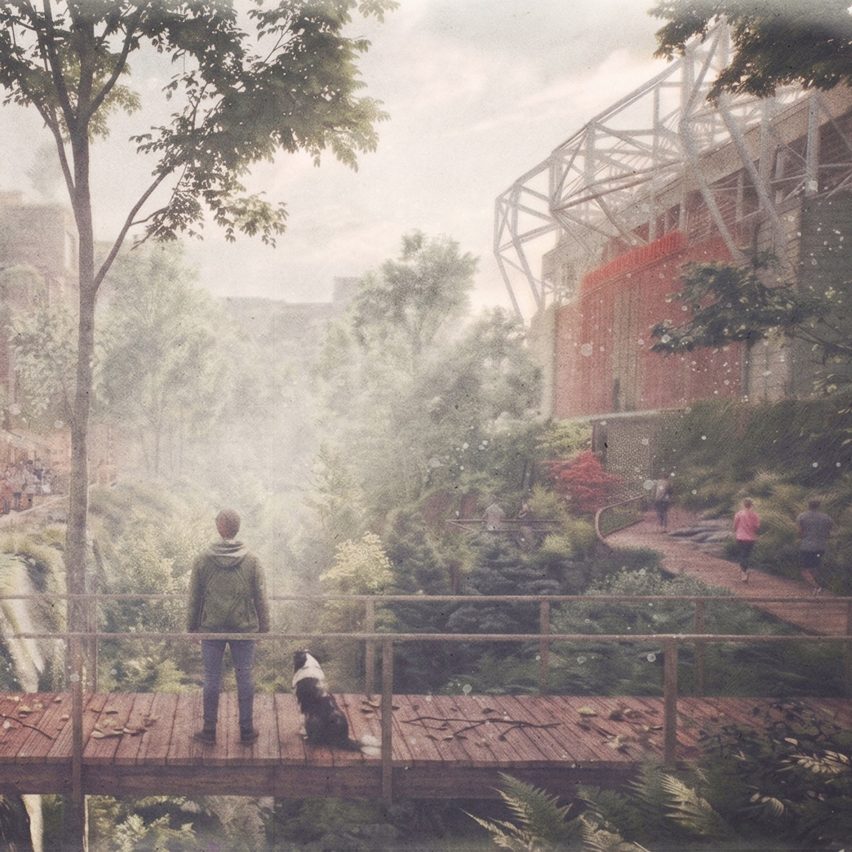
Dezeen School Shows: a proposal to surround the Manchester United football stadium with an urban forest is among the projects from the Manchester School of Architecture.
Also featured is a proposal to reimagine a university IT building into a student centre, and a redevelopment of a shopping centre.
Manchester School of Architecture
Institution: Manchester School of Architecture
Courses: Master in Architecture and Urbanism (MA A+U) and Master of Art in Architecture and Adaptive Reuse (MA AR)
Tutors: Loris Rossi, Marianna Cavada, Rob Hyde, Curtis Martyn, Kristen Zhao, Glen Wash Ivanovic, Mazin Al-Saffar, Catalina Ionita, Matt Quayle, Dhruv Sookhoo, David Johnson, Azreen Azlan, Joren Heise, Sally Stone, Eamonn Canniffe, Ranbir Lal, Gareth Puttock, Roger Stephenson and Alberto V Yebenes
School statement:
“Manchester School of Architecture has two substantial MA programmes that examine architecture through the transformation of cities, buildings and existing places: the MA Architecture and Urbanism and the MA Architecture and Adaptive Reuse.
“The MA Architecture and Urbanism positions architecture within the cultural, economic and environmental forces shaping contemporary urban life. Through the Urban Labs, students work through a multi-scale design process, moving from city-scale analysis to neighbourhood strategies and architectural intervention.
“Based in Manchester, the programme treats the city as an active urban laboratory, where theory, research methodologies, and practice-oriented design converge. Through three thematic Urban Labs, Contextual Urbanism, Prototype Urbanism, and Dwelling and Urbanism, students critically explore contemporary urban challenges while developing speculative and future-oriented design responses.
“The MA Architecture and Adaptive Reuse focuses on the future of existing buildings, situations and places. Students explore how structures can evolve over time, sustain new uses and accommodate new users. Adaptation is approached as a creative and sustainable act, informed by history, memory, context and environmental responsibility.
“Projects examine the technical and spatial implications of reuse, including construction, environmental control and materials, while developing proposals for buildings and situations whose social and functional needs are changing.
“Together, the programmes present architecture as a discipline working with the already existing: cities in flux, buildings in transition and futures still open to design.”

The Beta District: An Urban Prototype in Trafford by Dwij Ashar
“The Prototype Urbanism Laboratory challenges students to harness the power of AI, computational tools and speculative design to imagine truly smart and liveable cities of the future.
“The Beta District is a speculative hybrid physical-digital urban district in Old Trafford. The project is conceived as a 1:1 living research laboratory – a prototype to be tested, refined and scaled across Trafford.
“Multi-objective computational optimisation grounded in humanist urban theory and sustainability was used to prototype an entirely new model of urban living.
“Augmented reality, real-time wayfinding and personalised environmental systems are woven seamlessly into the urban fabric.”
Student: Dwij Ashar
Course: MA Architecture and Urbanism – Prototype Urbanism Lab
Tutors: Marianna Cavada, Rob Hyde, Curtis Martyn and Kristen Zhao

Old Trafford: Towards a Seamless Urban Flow by Samaher Tariq Bakhsh
“The Prototype Urbanism Lab explores smart urbanism through strategies that rethink how cities function socially, spatially, and environmentally.
“Old Trafford currently operates as a fractured urban site shaped by the contrast between the intensity of match days and the silence of everyday routines.
“The proposal introduces three interconnected flow systems that transform existing barriers into linking points to re-stitch the fragmented urban fabric.
“The High-Intensity Flow manages crowd movement during events, the Daily Urban Flow reconnects surrounding neighbourhoods through porous public space and the Recreational Flow activates the canal edge while strengthening the cultural connection toward the Imperial War Museum North, creating a continuous and socially active urban experience.”
Student: Samaher Tariq Bakhsh
Course: MA Architecture and Urbanism – Prototype Urbanism Lab
Tutors: Marianna Cavada, Rob Hyde, Curtis Martyn and Kristen Zhao

Civic Gradient: Rebalancing Old Trafford by Luyang Song
“Prototype Lab asks students to test urban prototypes for future cities through architectural, digital and civic speculation.
“Luyang Song’s Civic Gradient reimagines Old Trafford as an everyday civic-sports district, shifting it from a stadium-led event zone toward a shared public realm.
“The project responds to fragmented governance, match-day intensity and weak everyday connections around the stadium by introducing a triangulated field of folded canopies, civic routes, canal links, community rooms and open landscapes.
“These interventions connect Old Trafford Stadium, the Bridgewater Canal, transport edges and surrounding neighbourhoods, making publicness, participation and urban life more visible across the district.”
Student: Luyang Song
Course: MA Architecture and Urbanism – Prototype Urbanism Lab
Tutors: Marianna Cavada, Rob Hyde, Curtis Martyn and Kristen Zhao
Email: slydmn666[at]outlook.com

The Green Heart of Arndale by Lin Gan
“This project redevelops Manchester Arndale Centre by proposing a Green Heart as the ecological and social core of the dense city centre commercial fabric.
“It turns mundane traffic streets into lush green corridors, threading scattered pocket parks, civic lawns and intimate green nodes into one seamless public network.
“Soft urban edges replace harsh built boundaries, inviting pedestrians to linger, socialise and reconnect with nature amid dense retail blocks.
“Blending ecological restoration, walkable circulation and layered public activities, the design rewrites Manchester’s downtown narrative – where commerce breathes with greenery and urban life meets wild, everyday nature.”
Student: Lin Gan
Course: MA Architecture and Urbanism – Contextual Urbanism Lab
Tutors: Glen Wash Ivanovic, Mazin Al-Saffar, Catalina Ionita and Matt Quayle

The Porous Heart by Zhuoqin Zhang
“”The Contextual Urbanism Laboratory is devoted to thinking about and designing urban proposals that serve as links between a city’s heritage and its future.
“The atelier is concerned with examining the past and defining future morphologies that, while rooted in history, propose material urban expressions of possible cultural evolutions.
“The current Arndale functions as an ‘Urban Dam’, obstructing the natural pedestrian flow across the city.
“This proposal aims to transform the huge inward commercial box into a permeable, climate-responsive network. Offering human-scale streetscapes, a mix of land uses, a robust urban framework, a clear hierarchy of urban elements and a well-connected public space.”
Student: Zhuoqin Zhang
Course: MA Architecture and Urbanism – Contextual Urbanism Lab
Tutors: Glen Wash Ivanovic, Mazin Al-Saffar, Catalina Ionita and Matt Quayle

The Ground Remembers: Reweaving Manchester’s Lost Urban Fabric by Sreoshi Datta
“The atelier investigates urban identity, memory, and the reinstatement of lost civic fabric through contextual master planning at the city scale.
“The Ground Remembers proposes the reinstatement of Canon Street and Marsden Square within Manchester’s Arndale site, a quarter erased twice by post-war clearance and the 1996 IRA bombing.
“Operating through three layers of reinstatement, physical, temporal and sensory, the scheme subdivides the monolithic superblock into four human-scale quadrants, recovering street permeability, civic ground and mixed-use urban life.
“The result is not reconstruction, but morphological repair: a city that reads its own history beneath your feet.”
Student: Sreoshi Datta
Course: MA Architecture and Urbanism – Contextual Urbanism Lab
Tutors: Glen Wash Ivanovic, Mazin Al-Saffar, Catalina Ionita and Matt Quayle

Past the Garden Wall: A Spatial Response to Loneliness by Yaman Al Ghammari
“The Dwelling and Urbanism Lab at the Manchester School of Architecture explores how suburban neighbourhoods can be sensitively intensified through housing, landscape and social life.
“Set in Collyhurst, Past the Garden Wall reframes loneliness as a spatial question, asking what happens in the small distances between front door, garden wall and street.
“The proposal transforms defensive boundaries into permeable thresholds, shared courtyards, active edges and visible routes, while respecting existing residents, routines and privacy.
“Rather than producing density alone, the project treats suburban intensification as careful repair, using architecture and landscape to rebuild everyday recognition, informal support and neighbourly life.”
Student: Yaman Al Ghammari
Course: MA Architecture and Urbanism – Dwelling and Urbanism Lab
Tutors: Dhruv Sookhoo, David Johnson, Azreen Azlan and Joren Heise

The Afterlife of an Activated Viaduct: Spaces of Hope in Collyhurst by Tanmay Newaskar
“Developed within the Dwelling and Urbanism Urban Laboratory, this project explores suburban intensification in South Collyhurst, within the wider context of Manchester.
“The atelier examines how future suburban growth can retain the emotional, social and spatial qualities that define neighbourhood life, while adapting to evolving urban pressures.
“Viaducts of Hope proposes an affective urban framework that reactivates an abandoned viaduct as an interactive civic landscape.
“The design weaves together private housing and a public viaduct plaza through a transitional co-working block inserted along the existing arches.
“A new pedestrian overbridge strengthens connectivity, encourages everyday social exchange and improves safety and passive surveillance along the once-neglected viaduct corridor.”
Student: Tanmay Newaskar
Course: MA Architecture and Urbanism – Dwelling and Urbanism Lab
Tutors: Dhruv Sookhoo, David Johnson, Azreen Azlan and Joren Heise

Break the Block by Ruiqi Zhu and Weixian Cai
“The MAAR Concepts module challenges students to explore adaptive reuse strategies. This project, inspired by the themes of boundary-breaking in Tara Westover’s memoir Educated, revitalises the University of Manchester’s secluded Information Technology Building into a dynamic graduate centre.
“Designed by Ruiqi Zhu and Weixian Cai, the architectural intervention shatters the original enclosed layout.
“To resolve the awkwardly positioned main entrance, a striking red-brick tower acts as a new wayfinding beacon.
“Inside, a massive tiered staircase navigates the complex east-west split-levels and existing third-floor skybridge, beautifully blending Manchester’s industrial heritage with modern adaptability under new skylights.”
Students: Ruiqi Zhu and Weixian Cai
Course: MA Architecture and Adaptive Reuse
Tutors: Sally Stone, Eamonn Canniffe, Ranbir Lal, Gareth Puttock, Roger Stephenson and Alberto V Yebenes

Information Technology Centre – Shifting Thresholds by Harry Colton and Walaa Osman
“The Concepts module is an introductory module on the core principles of adaptive reuse, based upon the transformation of the UoM IT building into a postgraduate student centre.
“A successful project demonstrates sensitivity to existing foundations while introducing considered, effective interventions.
“Despite largely mundane design foundations, the building’s functional systems contain unique postmodern characteristics.
“Through the extraction and reinterpretation of these qualities, a playful design strategy emerges rooted in basic geometric forms and bold colouring.
“The resulting contemporary interventions coexist with existing engineering bricks, CMUs and yellow detailing, responding to the building’s new, less formal occupation.
“Circulation and accessibility challenges arising from the split-level design were resolved through opening the arcade and introducing bold yellow feature staircases.”
Students: Harry Colton and Walaa Osman
Course: MA Architecture and Adaptive Reuse
Tutors: Sally Stone, Eamonn Canniffe, Ranbir Lal, Gareth Puttock, Roger Stephenson and Alberto V Yebenes

Rewiring: The New Postgraduate Centre by Keti Katchkatchuri, Rodrigo Arevalo del Aguila and Zuzanna Wieczór
“The Concepts module of the MA Architecture and Adaptive Reuse programme introduced students to three core strategies for successfully achieving a change of function in an existing building: Intervention, Insertion, and Installation.
“Within this scope, the final project consisted of transforming the University of Manchester’s Information Technology Building into a new Postgraduate Centre.
“Inspired by the 1960’s vision for Manchester ‘Streets in the Sky’, the proposal drew from the building’s existing circulation routes and structural logic to introduce a decisive intervention that removed the central Art Deco volume and rewired the two blocks through a new series of connective bridges.
“These complementary spaces became the project’s social core, accommodating meetings, study and reading areas.”
Students: Keti Katchkatchuri, Rodrigo Arevalo del Aguila and Zuzanna Wieczór
Course: MA Architecture and Adaptive Reuse
Tutors: Sally Stone, Eamonn Canniffe, Ranbir Lal, Gareth Puttock, Roger Stephenson and Alberto V Yebenes

Dialogue in Curves by Beining Zhang, Jiage Gong and Mingze Zhang
“The MA Architecture and Adaptive Reuse (MAAR) Concepts module challenges students to explore adaptive reuse strategies through existing buildings and evolving social needs.
“This group proposal reimagines an existing IT Building as a postgraduate research and activity centre.
“Developed under the theme Space Dialogues, the project draws inspiration from The Little Prince, exploring how architecture can encourage imagination, interaction and emotional connection.
“The design reinterprets the building’s rigid structure through curved insertions, glass archways, and new circulation routes, creating a dialogue between old and new spaces while fostering a more open and collaborative academic environment.”
Students: Beining Zhang, Jiage Gong and Mingze Zhang
Course: MA Architecture and Adaptive Reuse
Tutors: Sally Stone, Eamonn Canniffe, Ranbir Lal, Gareth Puttock, Roger Stephenson and Alberto V Yebenes

Decoding the Invisible by Yiyao Liu and Shuyuan Qin
“Inspired by Italo Calvino’s Invisible Cities, “Decoding the Invisible” explores how architecture can translate intangible systems, memories and social relationships into physical spatial experiences.
“The design attempts to interpret Calvino’s urban archetypes into spatial intervention strategies, establishing a dialogue between old and new.
“Reimagining the University of Manchester’s former Information Technology Building as a postgraduate centre, the proposal preserves its distinctive Manchester red-brick facade and original corridor ventilation systems.
“These retained elements work alongside newly introduced features, including a central light-well atrium, a greenhouse roof and a shared rooftop garden.
“By transforming hidden digital networks into visible community connections, we hope to renew this former technological building into a tactile and inclusive social hub that fosters research, relaxation and daily interaction.”
Students: Yiyao Liu and Shuyuan Qin
Course: MA Architecture and Adaptive Reuse
Tutors: Sally Stone, Eamonn Canniffe, Ranbir Lal, Gareth Puttock, Roger Stephenson and Alberto V Yebenes

The Voxel Forest – Rewilding Old Trafford by Roopendra Kumar Prabhakaran
“The Voxel Forest at the Old Trafford is a space offering a rewilding approach to the ever-needed question of how we deal with the abundance of space during non-match days?
“This is in response to the theoretical underpinning of a systems approach of truly smart urbanism within the Prototype Lab.
“Translating Old Trafford’s global cultural axes into a data-driven spatial grid, the proposal replaces extends (or a better word) industrial grey heritage with a mixed-use urban forest — rewilded, permeable, inhabited and growing year-round.
“Ecology is the infrastructure; the voxel is the unit, which grows and overtakes the contested space around the stadium.”
Student: Roopendra Kumar Prabhakaran
Course: MA Architecture and Urbanism – Prototype Urbanism Lab
Tutors: Marianna Cavada, Rob Hyde, Curtis Martyn and Kristen Zhao
Partnership content
This school show is a partnership between Dezeen and Manchester School of Architecture. Find out more about Dezeen partnership content here.
The post Urban forest surrounding stadium among projects from Manchester School of Architecture appeared first on Dezeen.