
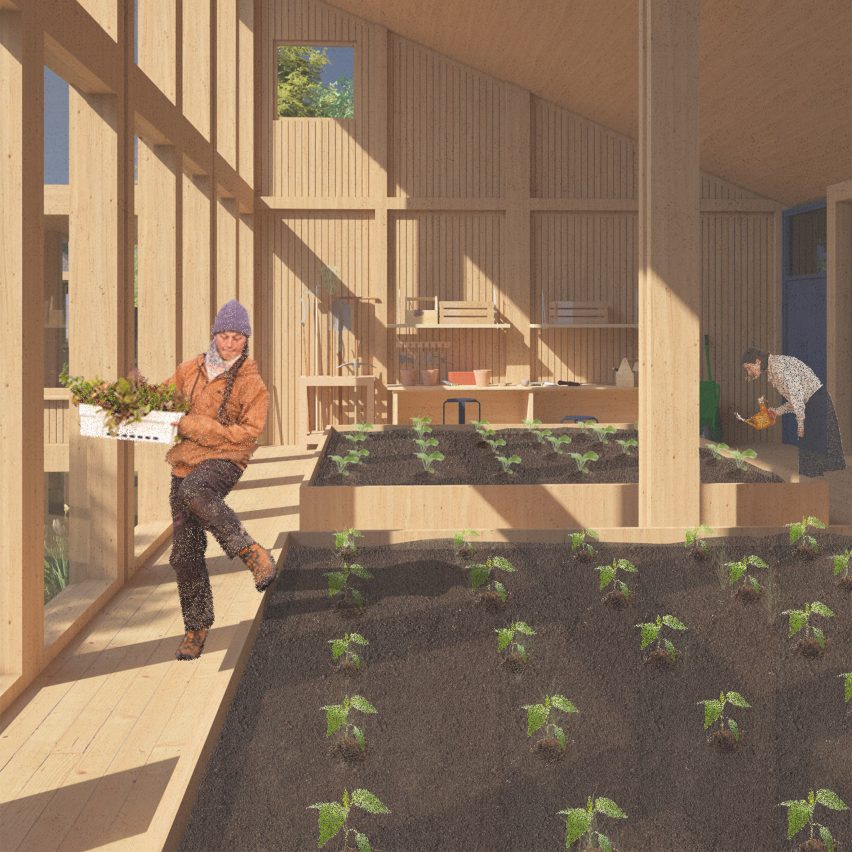
Dezeen School Shows: an ecological repair site in a post-industrial area of Manchester, UK, is among projects from the Manchester School of Architecture.
Also featured is a proposal to improve social wellbeing and a performance venue built beside a railway track that incorporates its acoustics.
Manchester School of Architecture
Institution: Manchester School of Architecture
Course: Master of Architecture (MArch) and Master of Landscape Architecture (MLA)
Tutors: Stefan White, Paul Robinson, Jakleen Al-Dalal’a, Mahmud Tantoush, Ulysses Sengupta, Michael O’Reilly, John Lee, Stephen Hodder, Lucy Montague, Dan Dubowitz, Hazem Ziada, Vilius Petraitis, Lisa Kinch, Nick Nilsen, Richard Morton, Vikram Kaushal, Rosa Urbano Gutiérrez, Ranbir Lal, Ray Lucas, Matt Ault, Neil Allen, Julie Fitzpatrick, Polly North, Charlie White, Debapriya Chakrabarti, Christopher Maloney, Sarah Renshaw, Bernadette Bone, Sarah Joyce, Azreen Azlan, Victoria Adegoke, Lorenza Casini, Kasia Nawratek, German Nieva, Rob McCarthy, Jens Haendeler, Eddy Fox, Sandeep Balagangadharan Menon and Mingyu Jiang
School statement:
“Manchester School of Architecture’s Master of Architecture and Master of Landscape Architecture programmes bring architecture and landscape into dialogue as professionally accredited, research-led disciplines responding to climate, social and spatial change.
“Situated in a city shaped by industrial inheritance, urban transformation and ecological challenge, the programmes use Manchester and wider global contexts as testing grounds for future practice.
“Students work across scales, from building fabric and civic infrastructure to landscape systems, biodiversity and territories, developing propositions that are speculative, technically grounded and socially engaged.
“The MArch supports students to become autonomous agents of positive change: future-literate practitioners able to challenge conventions, define their own professional pathways and contribute to the evolution of architecture.
“The MLA addresses the urgent need for landscape architects capable of designing inclusive, climate-resilient places where ecological integrity, social need and imagination meet.
“Across research-led studios, collaborative workshops and live stakeholder engagements, students test how design can operate between theory and implementation.
“Together, the work presented here reflects MSA’s commitment to educating emerging practitioners who can move between architecture and landscape, speculation and responsibility, to shape more just, resilient and ecologically responsive futures.”
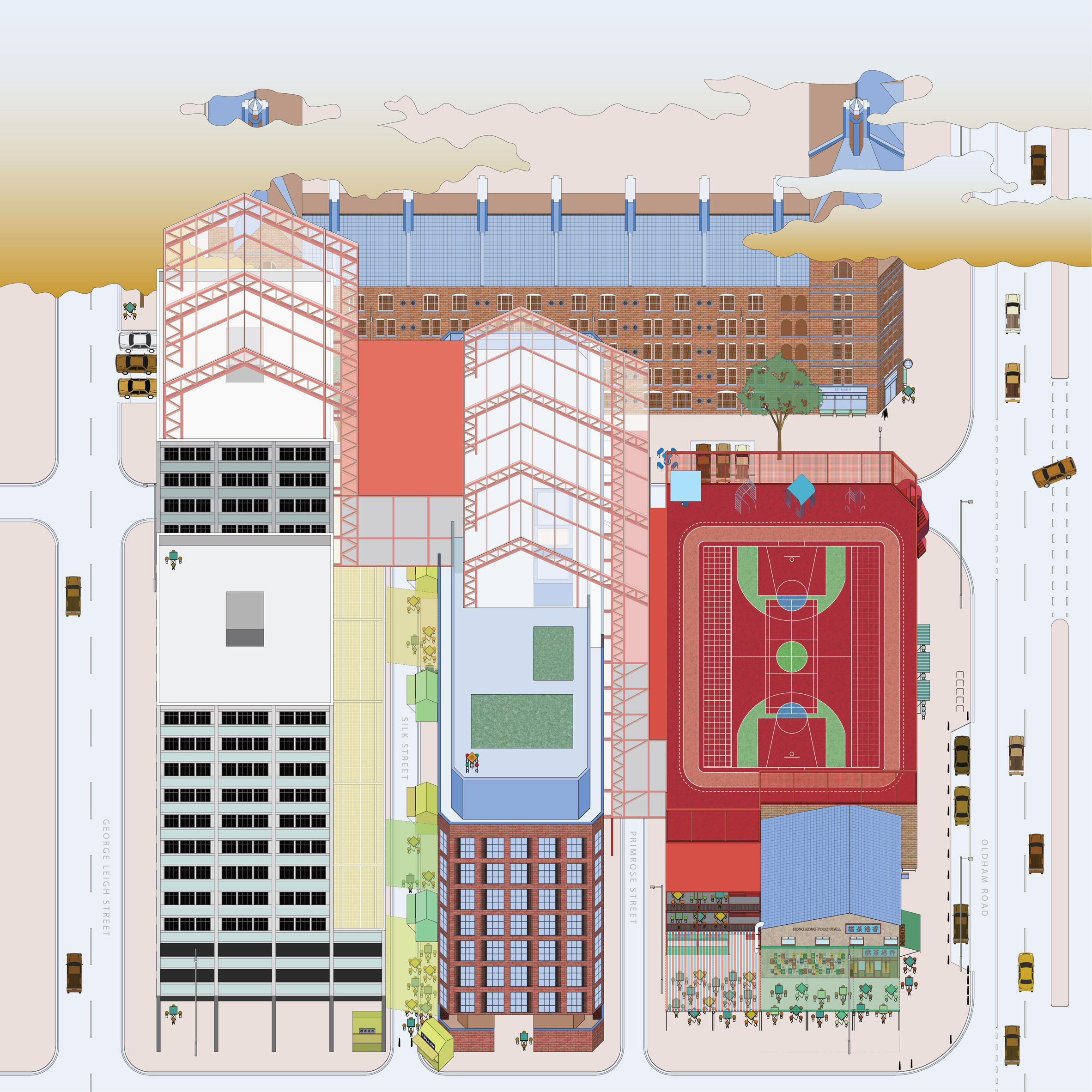
The Social Fusion Laboratory: Importing Hong Kong Resilience to Manchester by Tsz Kiu Jackie Cheung
“Aligned with the ‘Live Well’ agenda for Greater Manchester, Atelier Architecture investigates architecture’s power to improve health and social opportunity through neighbourhood-based initiatives.
“As Greater Manchester densifies, it risks social isolation. Hong Kong serves as a laboratory where extreme spatial constraints have birthed high-intensity typologies that effectively condense social life.
“The Social Fusion Laboratory addresses social disconnection in GM neighbourhoods with growing density by introducing a three-dimensional network of Hong Kong-inspired typologies into the post-industrial local context.
“The design translates the spatial efficiency and social fluidity of Hong Kong typologies into a social operating system of parasitic interventions across three scales: micro-leisure corners (mahjong inspired), meso-street-side stalls (daipaidong inspired) and macro-social condensers (municipal services building inspired).
“By reactivating overlooked urban spaces into connectors with varying levels of social intensity, the network fosters spontaneous interactions and knits together fragmented communities.”
Student: Tsz Kiu Jackie Cheung
Course: MArch Year 2 – Architecture Atelier
Tutors: Stefan White, Paul Robinson and Jakleen Al-Dalal’a
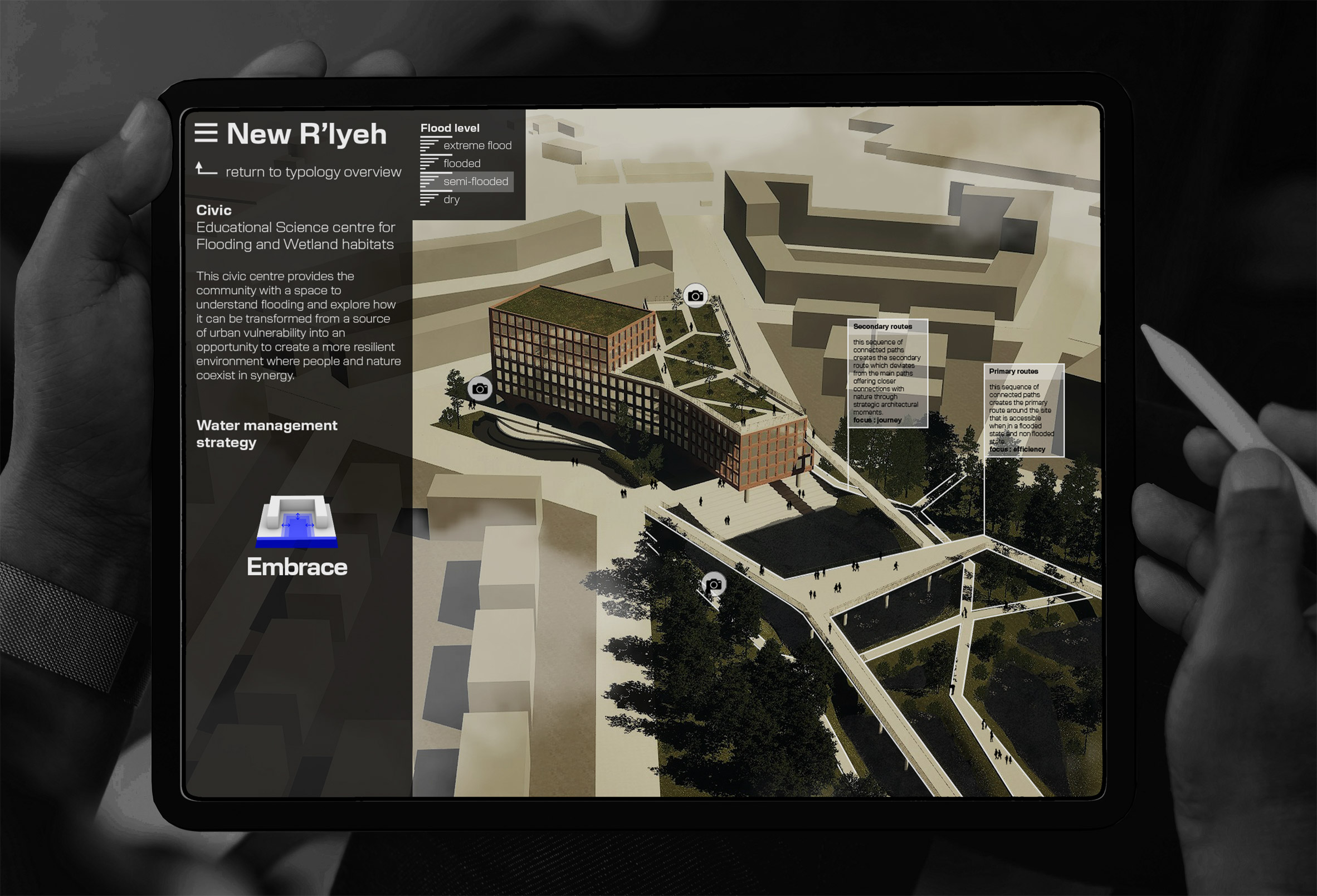
New R’lyeh by George Cox
“The [CPU]ai Atelier explores future cities through the development of bespoke design methodologies and computational tools informed by Complex Adaptive Systems and futures theory.
“In New R’lyeh, George Cox engages with climate change as a projected future in which increasingly frequent and unpredictable extreme weather events drive the development of new adaptive architectural typologies and spatial strategies that address flooding and ecological degradation.
“Using ecological resilience theory, the project develops a computational methodology through bespoke tools, spatial strategies and iterative scenario testing, exploring how water can be slowed, captured, absorbed, stored and ultimately embraced enabling new spatial possibilities within future cities.
“An interactive app is used to allow the project to be experienced as a dynamic and participatory tool, giving wider audiences and interdisciplinary stakeholders the opportunity to explore, test and engage with future flooding scenarios.”
Student: George Cox
Course: MArch Year 2 – [CPU]ai Atelier
Tutors: Mahmud Tantoush, Ulysses Sengupta and Michael O’Reilly
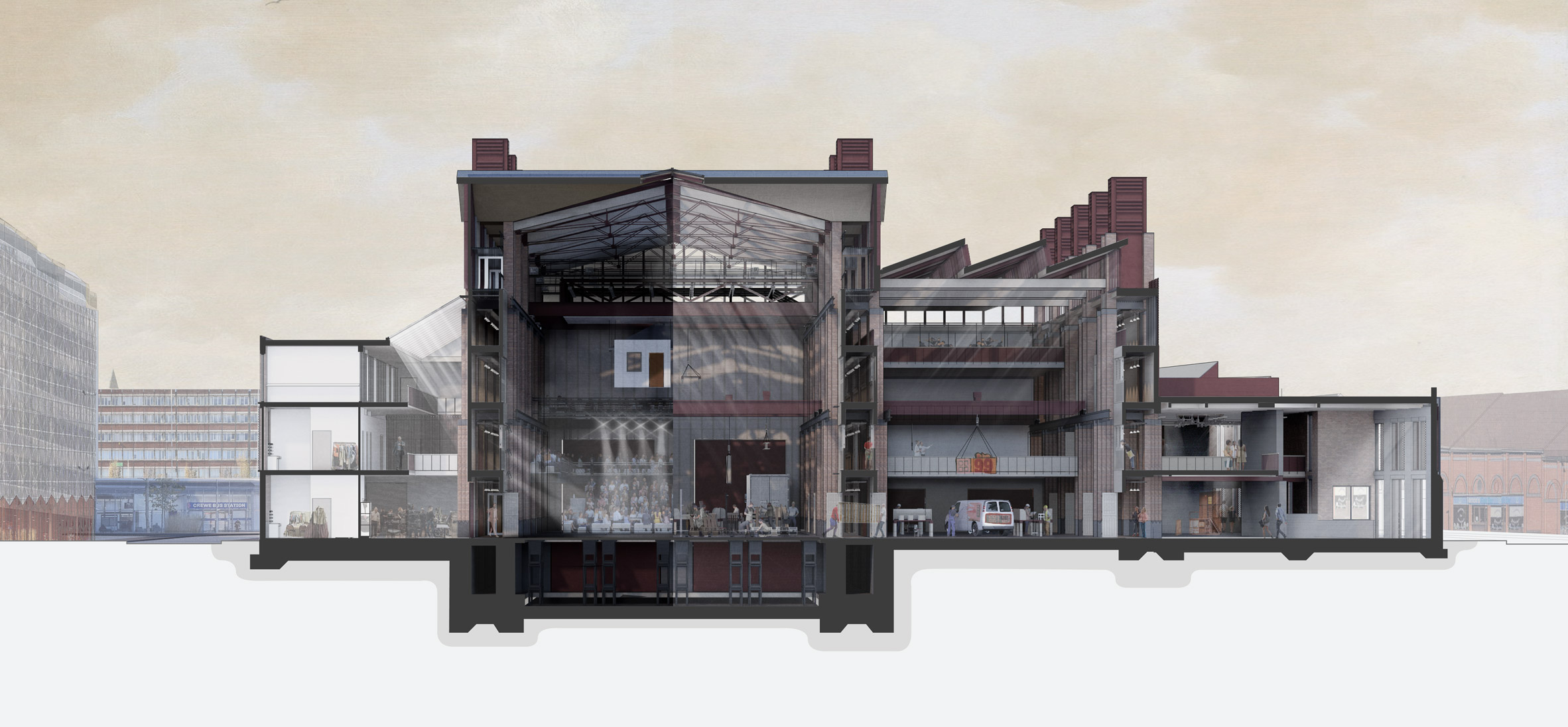
The Stanier and Bond Theatre by Luke Ferguson
“The Continuity Atelier returned to Crewe town centre with the ethos of ‘make do and mend’ interrogating the town’s tectonic, cultural and social narrative through craft, inspired by Cadwell’s ‘strange details’ to inform regenerative masterplans and individual proposals.
“The Stanier and Bond Theatre critically reinterprets the industrial heritage of Crewe Works, forming a productive civic heart of theatre, making and public participation, creating a site of active memory through place-specific architecture and event.
“Two adaptable halls housing theatre and workshop spaces encourage public engagement, allowing the craft to be a performance equal to the theatre itself.
“Overhead cranes span the halls, supported by natural ventilation towers, reflecting the lost chimneys of the works.”
Student: Luke Ferguson
Course: MArch Year 2 – Continuity Atelier
Tutors: John Lee, Stephen Hodder and Lucy Montague
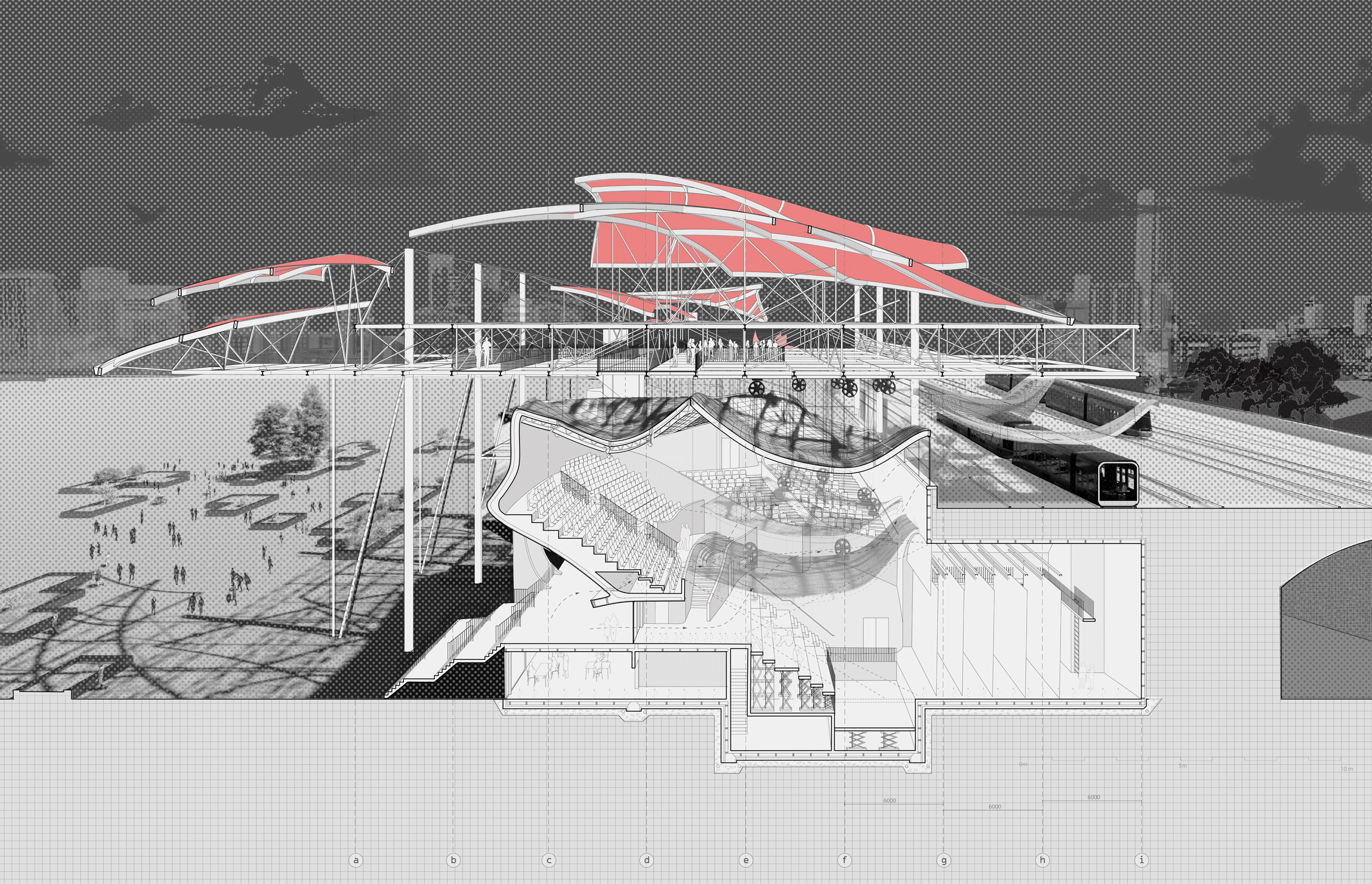
An Archipelagic Sounding of Shared Presence by Laura Popa
“Flux Atelier challenges students to examine architecture as a state of change, engaging deeply with site, people, and the shifting conditions of the city.
“Laura Popa’s project reflects this through an adaptable performance venue sitting within a wider archipelagic network of participatory acoustic interventions that follow the railway infrastructure.
“Rather than suppressing the city’s soundscape, the interventions incorporate passing trains into the performance, transforming the ordinary rhythms of urban life into intentionally curated affective environments.
“The venue shifts in size and configuration, responding to varying occupancy and acoustic needs through movable roof systems and flexible staging.
“By dissolving the boundaries between performer and spectator; between everyday life and performance, the proposal reframes architecture as a dynamic framework for collective experience, where sound operates as a mediator of connection.”
Student: Laura Popa
Course: MArch Year 2 – Flux Atelier
Tutors: Dan Dubowitz, Hazem Ziada and Vilius Petraitis
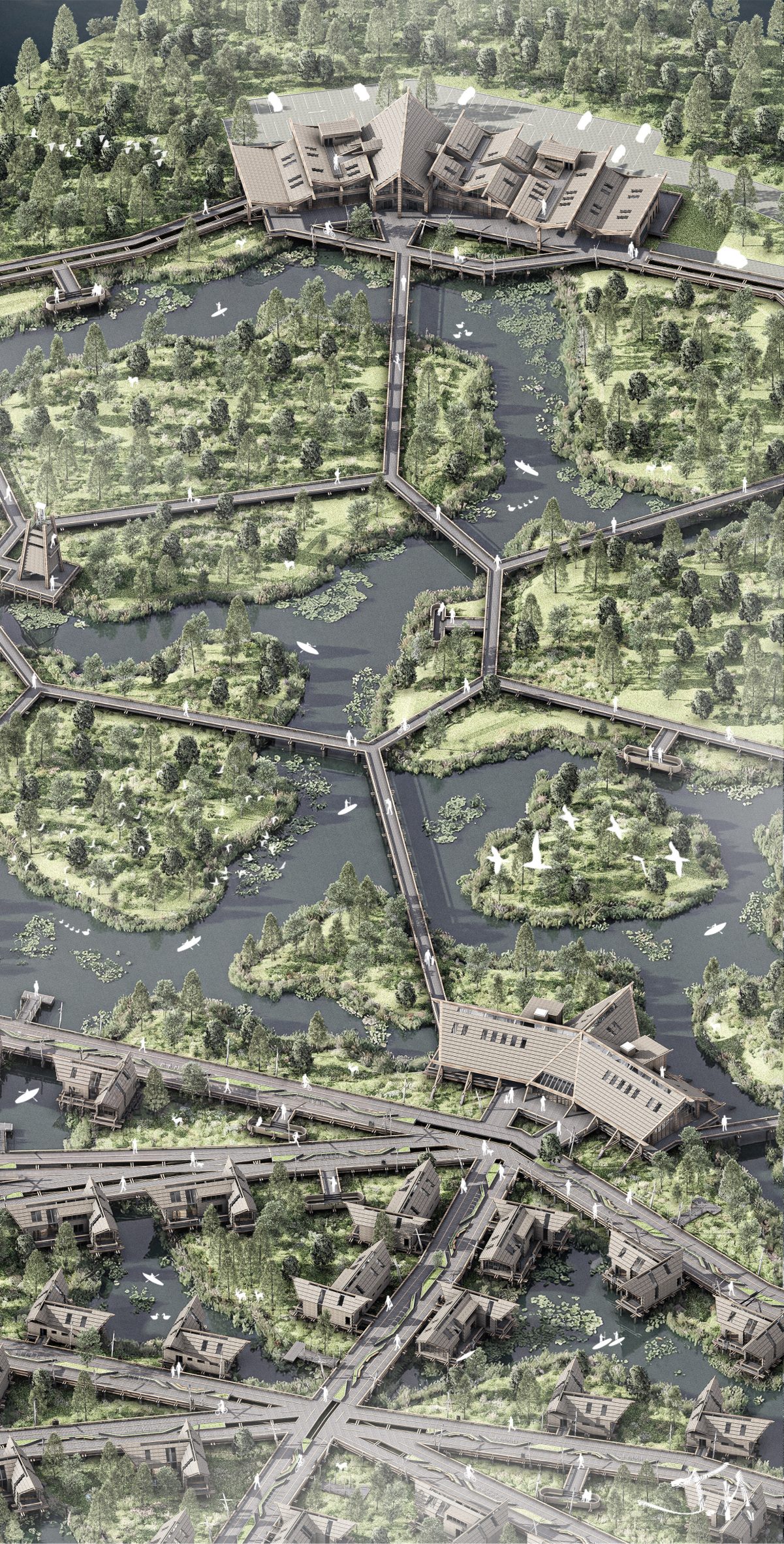
Credit Landscapes: Manipulating the Choreography between Biotic and Abiotic Boundaries by Jacob Hodgson
“The Infrastructure Space Atelier at MSA challenged students to use data-driven and speculative design to regenerate architectural infrastructure and land-use planning across St Cuthbert’s Garden Village and the River Eden Catchment, Carlisle, critically addressing community wellbeing, sustainability and regulatory compliance.
“Credit Landscapes, by Jacob Hodgson, is a speculative pilot housing-wetland cooperative embedded within a Cumbrian floodplain that uses architecture as a forensic tool to expose the immaturity of the UK’s Biodiversity Net Gain and Nutrient Neutrality ecological credit market.
“Inverting conventional development logic, wetland creation precedes built infrastructure, embedding credit generation, stewardship and verification directly into a modular, bio-based architectural program that offers a spatialised response to an abstract and manipulable legislative framework.”
Student: Jacob Hodgson
Course: MArch Year 2 – Infrastructure Space Atelier
Tutors: Lisa Kinch, Nick Nilsen, Richard Morton and Vikram Kaushal
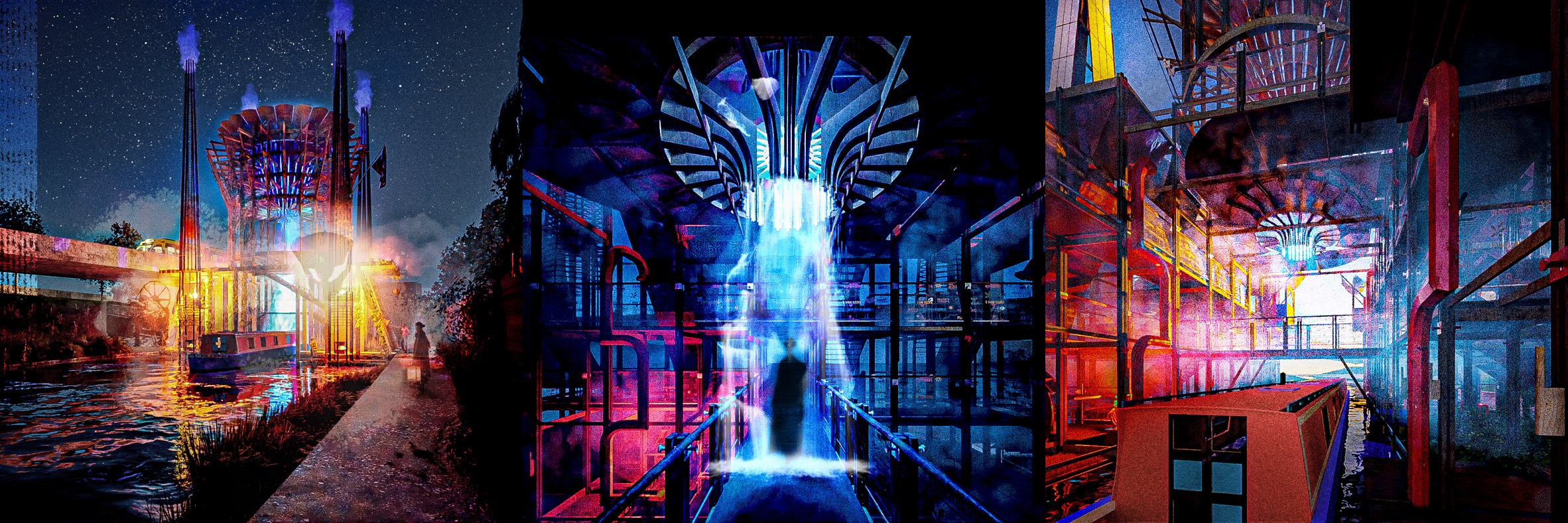
Antardhara by Shivsen Padhiar
“Project Antardhara, meaning ‘Undercurrents’, begins from the position that infrastructure is never neutral.
“Beneath the Bridgewater Canal’s narratives of industrial progress lie hidden histories of colonial extraction, labour and displacement that continue to shape Manchester today.
“Situated at Pomona Lock, the project seeks to re-vocabularise memorial through infrastructure itself, imagining what it might become if allowed to breathe, evolve and speak about the histories it has witnessed.
“Drawing from anti-colonial Swadeshi propaganda and atmospheric industrial imagery, Antardhara proposes an evolving architecture that remembers not through permanence or monumentality, but through weathering, participation, ecological reciprocity and collective acts of care over time.”
Student: Shivsen Padhiar
Course: MArch Year 2 – Praxis Atelier
Tutors: Debapriya Chakrabarti, Christopher Maloney, Sarah Renshaw, Bernadette Bone, Sarah Joyce, Azreen Azlan, Victoria Adegoke and Lorenza Casini
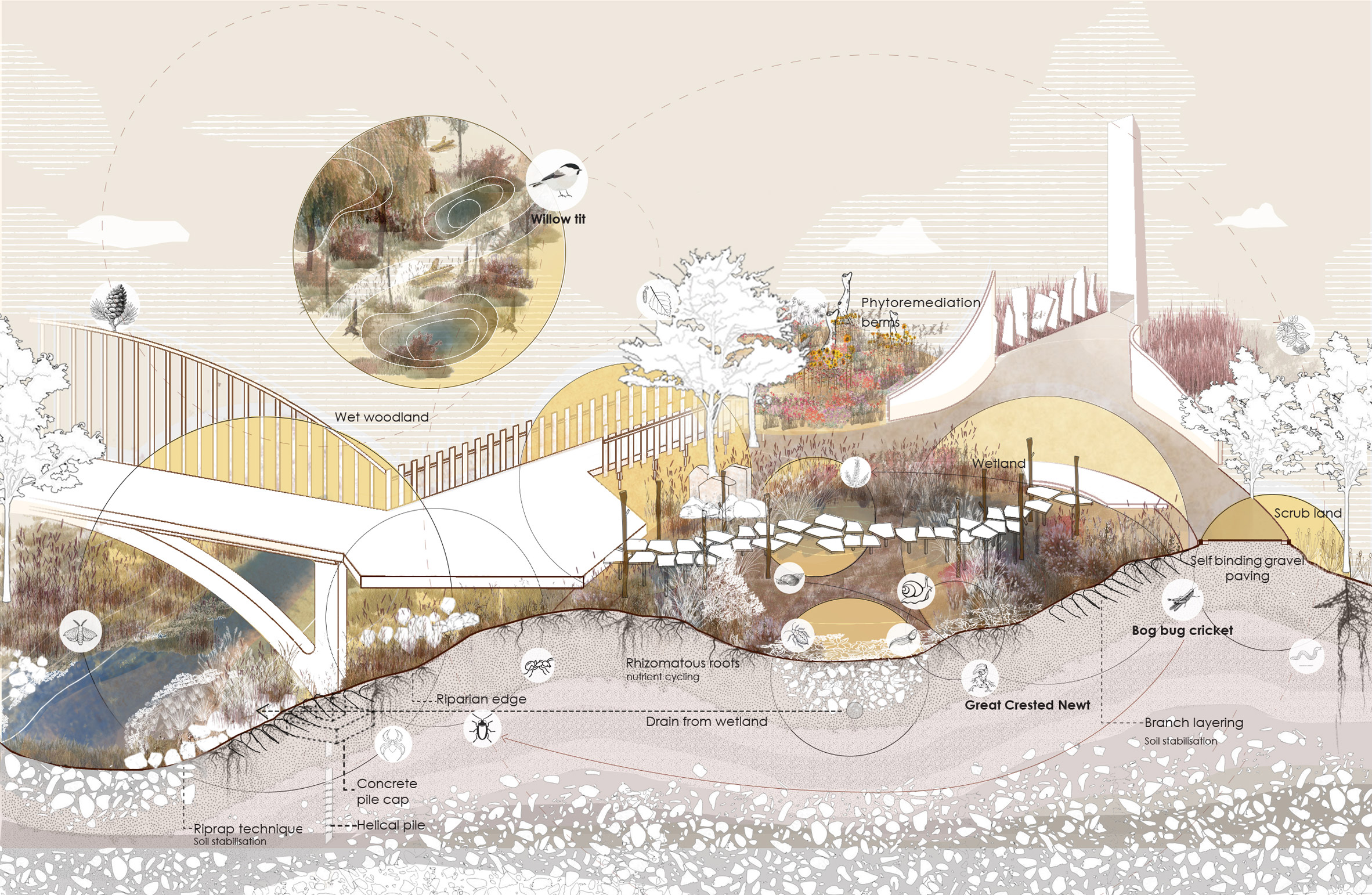
Memorial of Injustices by Swathikrishna Rajesh
“The project reimagines Pomona Island in Manchester as a public art landscape that critically engages with the impacts of climate change by daylighting the culverted River Cornbrook and highlighting ecological renewal through wetland creation, as a regenerative framework for biodiversity restoration.
“The design prioritises more-than-human life as its primary user and positions humans as spectators to allow space for ecological healing and renewal.
“Art serves as a medium for amplifying the injustices faced by more-than-human species and for revealing the remnants of past environmental damage, with public artworks functioning as living infrastructures that support biodiversity and enable the island’s ecosystem to regenerate and flourish.”
Student: Swathikrishna Rajesh
Course: MLA Year 2 – Some Kind of Nature Atelier
Tutors: Sandeep Balagangadharan Menon and Mingyu Jiang
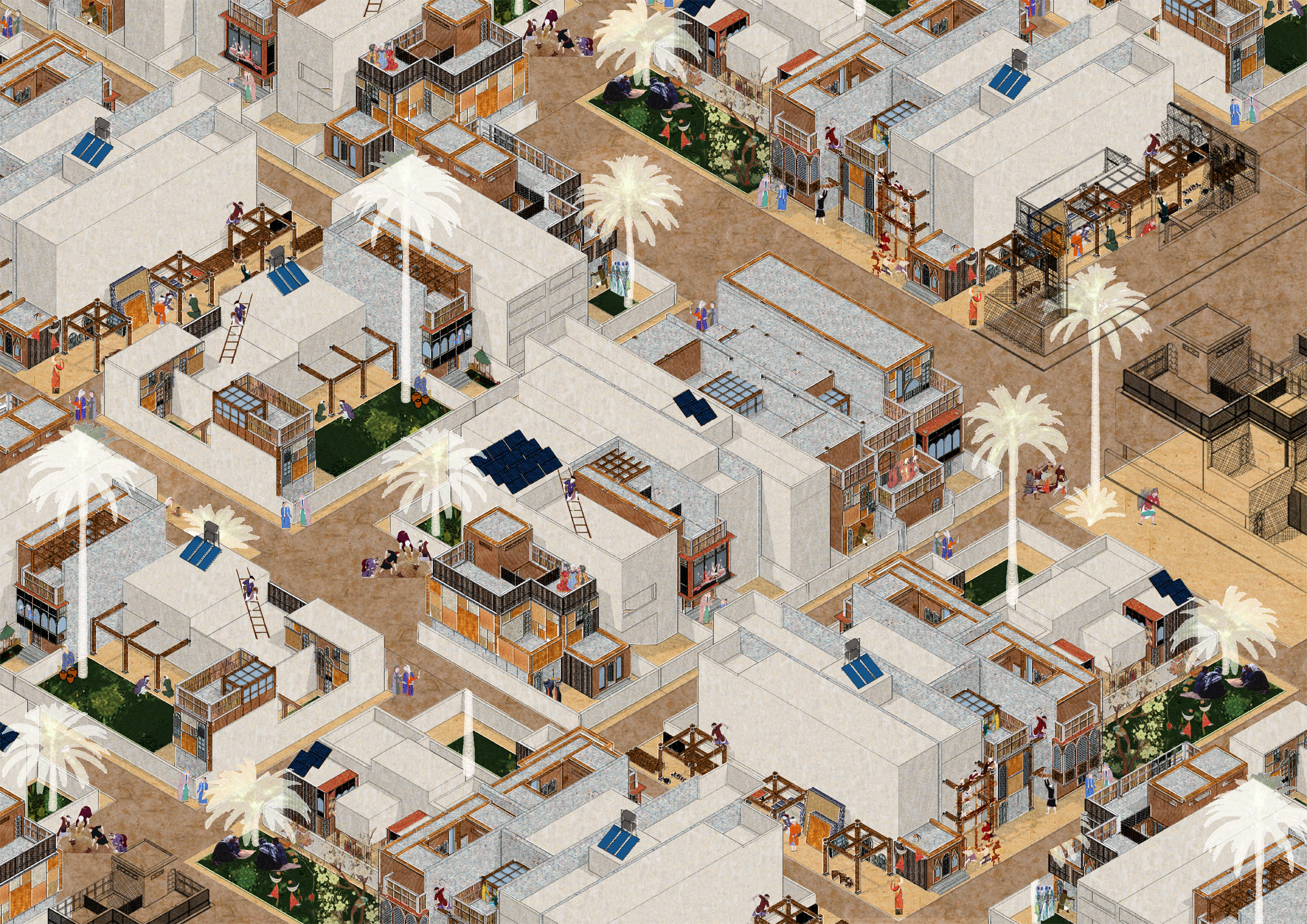
Humat Albayt (defenders/guardians/protectors of the home) by Marwa Al-Saqqar
“Praxis Atelier encourages students to examine societal inequalities through an intersectional feminist lens.
“Humat Albayt investigates the role of architecture in post-conflict contexts, particularly in Iraq, by collaborating with displaced and neglected Baghdadi residents impacted by the housing crisis that is exacerbated by political instability, corruption and the climate emergency.
“It applies ethnographic fieldwork to catalogue experiences of domesticity and employs allegorical drawings to prioritise memories and the immaterial as means to develop a taxonomy of domestic elements and a guidebook that support Iraqis articulate their needs and reclaim their spaces.
“Rather than a physical intervention, Humat Albayt serves as a spatial justice toolkit, exploring an alternative architectural process that engages in radical participatory methodologies to reshape the future of Iraq’s built environment towards a restorative one grounded in resilience, adaptability and the sacred practices of making that define Iraq’s rich tapestry.”
Student: Marwa Al-Saqqar
Course: MArch Year 2 – Praxis Atelier
Tutors: Debapriya Chakrabarti, Christopher Maloney, Sarah Renshaw, Bernadette Bone, Sarah Joyce, Azreen Azlan, Victoria Adegoke and Lorenza Casini
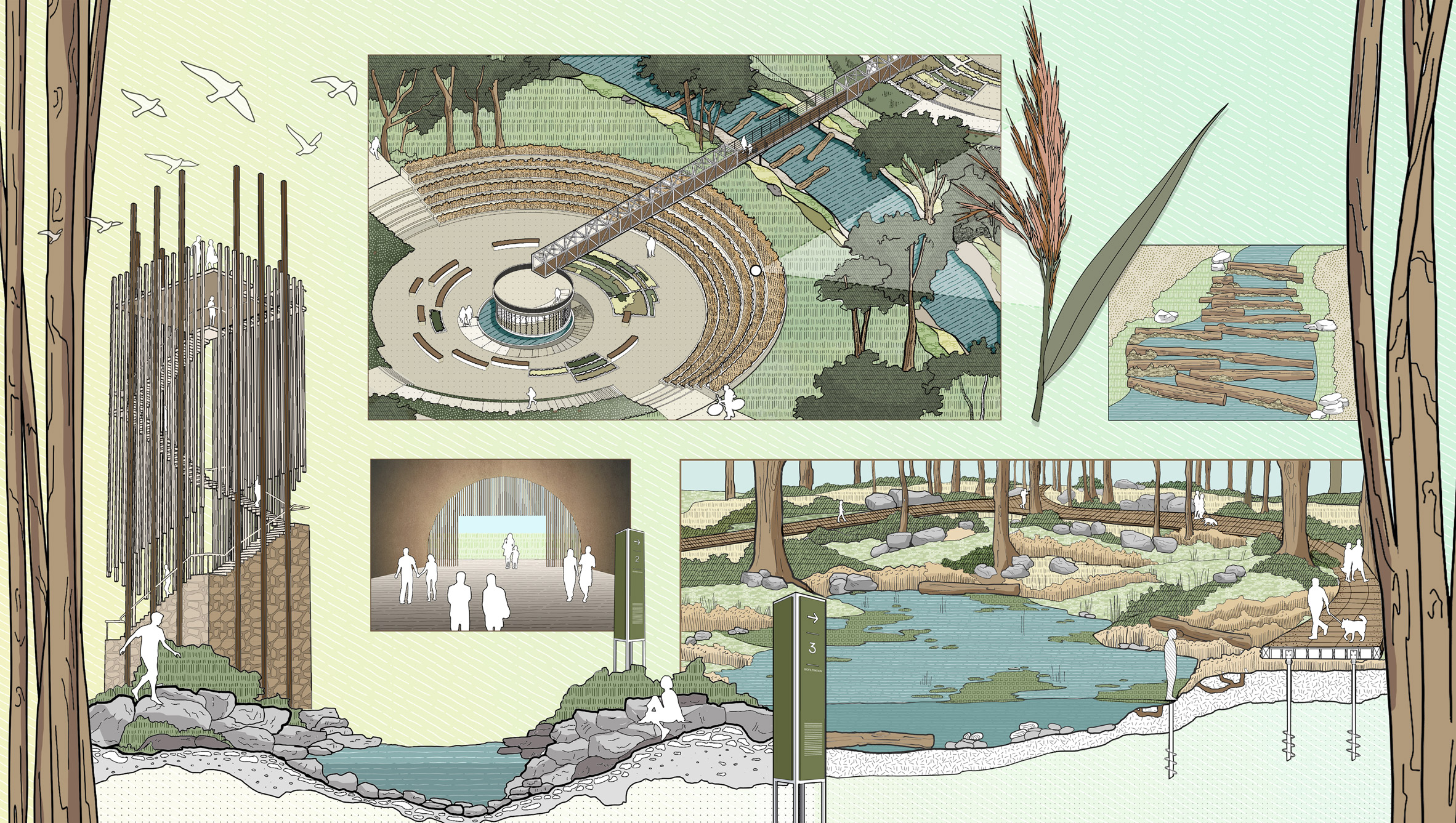
The Silent Filter: Practicing degrowth for wastewater filtration systems by Afreen Ubaid
“The Infrastructure Space atelier at MSA challenged students to reimagine existing infrastructure and land-use planning specifically looking at how St Cuthbert’s Garden Village must navigate restrictive planning, localised deprivation and nutrient neutrality trading frameworks along the River Eden catchment.
“The Silent Filter, by Afreen Ubaid, is a regenerative socioecological wastewater infrastructure situated opposite an existing treatment plant.
“Designed to translate rigid industrial processes such as screening, sedimentation, and filtration into a series of gravity-fed, biological water-purifying wetlands, the project merges hard and soft engineering into a living architectural landscape.
“These passive wetlands function as vital carbon sinks and biodiversity habitats, while serving as an active public demonstrator that physically engages communities with nature-based solutions to inspire future systemic replication.”
Student: Afreen Ubaid
Course: MLA Year 2 – Infrastructure Space Atelier
Tutor: Eddy Fox
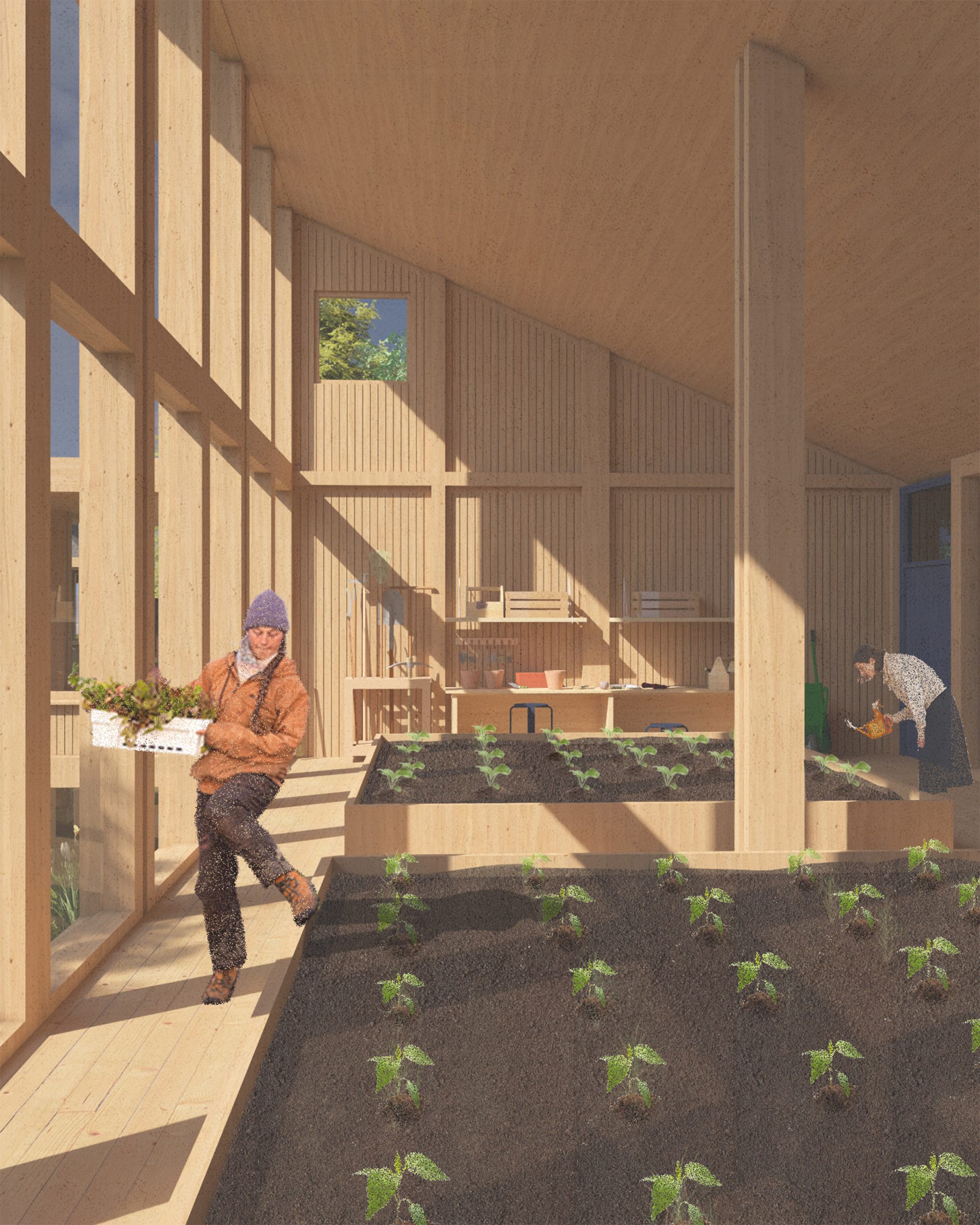
Succession of Care by Neel Naregal
“The Some Kind of Nature atelier adopts a post-humanist framework, decentring the designer to engage with human and non-human actors through care-based, collaborative and contextual practices.
“It responds to the climate and biodiversity crisis through process-driven approaches rooted in ecology, care and speculative thinking.
“Succession of Care proposes a non-linear cycle of ecological repair on the post-industrial landscape of Pomona Island, Manchester, which is shaped by contaminated soil and flood risk.
“It reimagines the island as a living ecological sponge, absorbing toxins through phytoremediation and flood-responsive interventions that work with natural processes rather than resisting them.
“Plants extract toxins from the soil, and the harvested biomass is transformed via slow pyrolysis into ceramic glazes, yielding building materials.
“The project demonstrates how architecture can become a framework for long-term resilience through maintenance and care.”
Student: Neel Naregal
Course: MArch Year 2 – Some Kind of Nature Atelier
Tutors: Kasia Nawratek, German Nieva and Rob McCarthy
Partnership content
This school show is a partnership between Dezeen and Manchester School of Architecture. Find out more about Dezeen partnership content here.
The post Ecological repair site among projects from Manchester School of Architecture appeared first on Dezeen.