
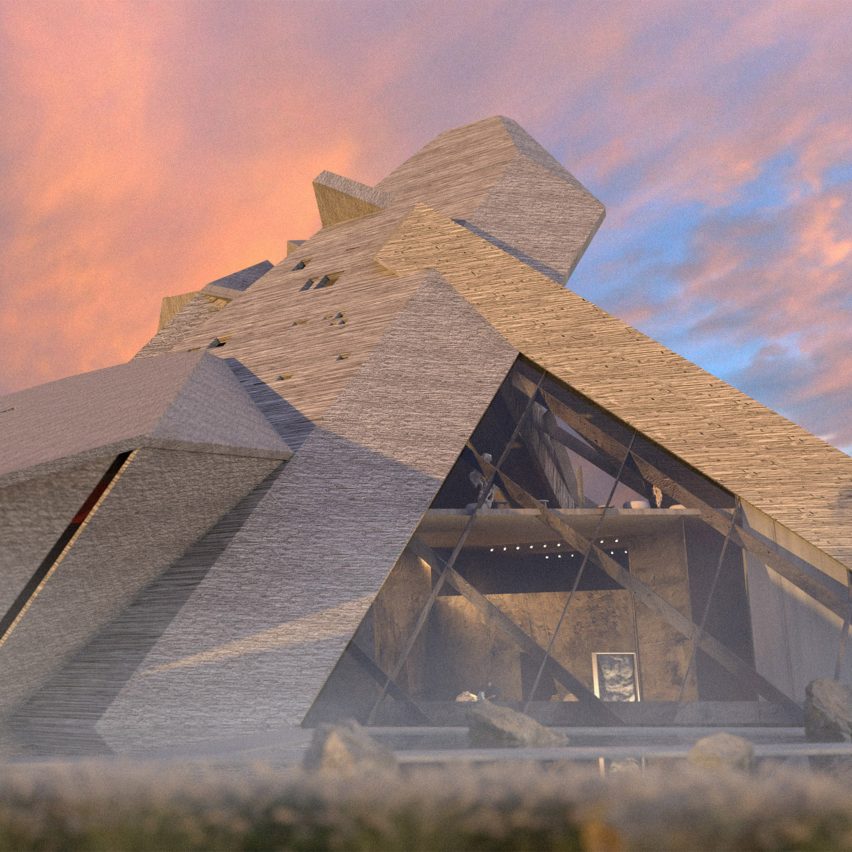
Dezeen School Shows: a proposal for a natural history museum equipped with a shard-like exterior to represent tectonic forces is among the projects from the Manchester School of Architecture.
Also featured is a project responding to the threat of skyscrapers in Manchester, UK, and another exploring the lack of affordable student accommodation.
Manchester School of Architecture
Institution: Manchester School of Architecture
Course: BA (Hons) Architecture
Tutors: Anna Gidman, Sam Holden, Curtis Martyn, David Johnson, Rob Hyde, Dan Newport, Johnathan Djabarouti, Mike Daniels, Neil Stevenson, Alberto Velazquez Yebenes, Dragana Opacic Wilkinson, Paul Robinson, Richard Morton, Lindsay Bush, Jo Hudson, Mike Burnell, Azreen Azlan, Victoria Adegoke, Lorenza Casini, Rosa Urbano Gutierrez, Ranbir Lal, Ray Lucas, Matt Ault, Neil Allen, Julie Fitzpatrick, Polly North, Charlie White, Guillermo Sanchez Sotes, Dan Renoso-Urmston, Stephen Walker, Kim Förster, Alan Lewis, Ewan Harrison, Leandro Minuchin, Gareth Puttock and Siobhan Barry
School statement:
“Situated within one of the UK’s fastest-transforming cities, Manchester School of Architecture positions architecture as a critical, creative and responsible response to environmental, social and material change.
“Jointly delivered by Manchester Metropolitan University and The University of Manchester, the BA (Hons) Architecture programme brings together studio, humanities and technologies as interconnected ways of understanding and shaping the built environment.
“Students are encouraged to test ideas through design while developing the cultural, technical and environmental knowledge needed to situate architecture within a wider world.
“Studio teaching supports bold, curious and experimental propositions, while humanities expands architectural thinking beyond canonical histories and theories, tracing global movements, interdependencies and the political forces that shape cities.
“Technologies enable students to investigate material systems, environmental performance and construction methods, connecting imagination with the practical demands of climate-conscious design.
“From social justice and sustainability to biodiversity, representation and building performance, students explore architecture as both cultural practice and technical discipline.
“The work presented here reflects an undergraduate culture that is intellectually ambitious, environmentally alert and professionally grounded, preparing emerging designers to engage creatively with the complex futures of architecture, cities and communities.”
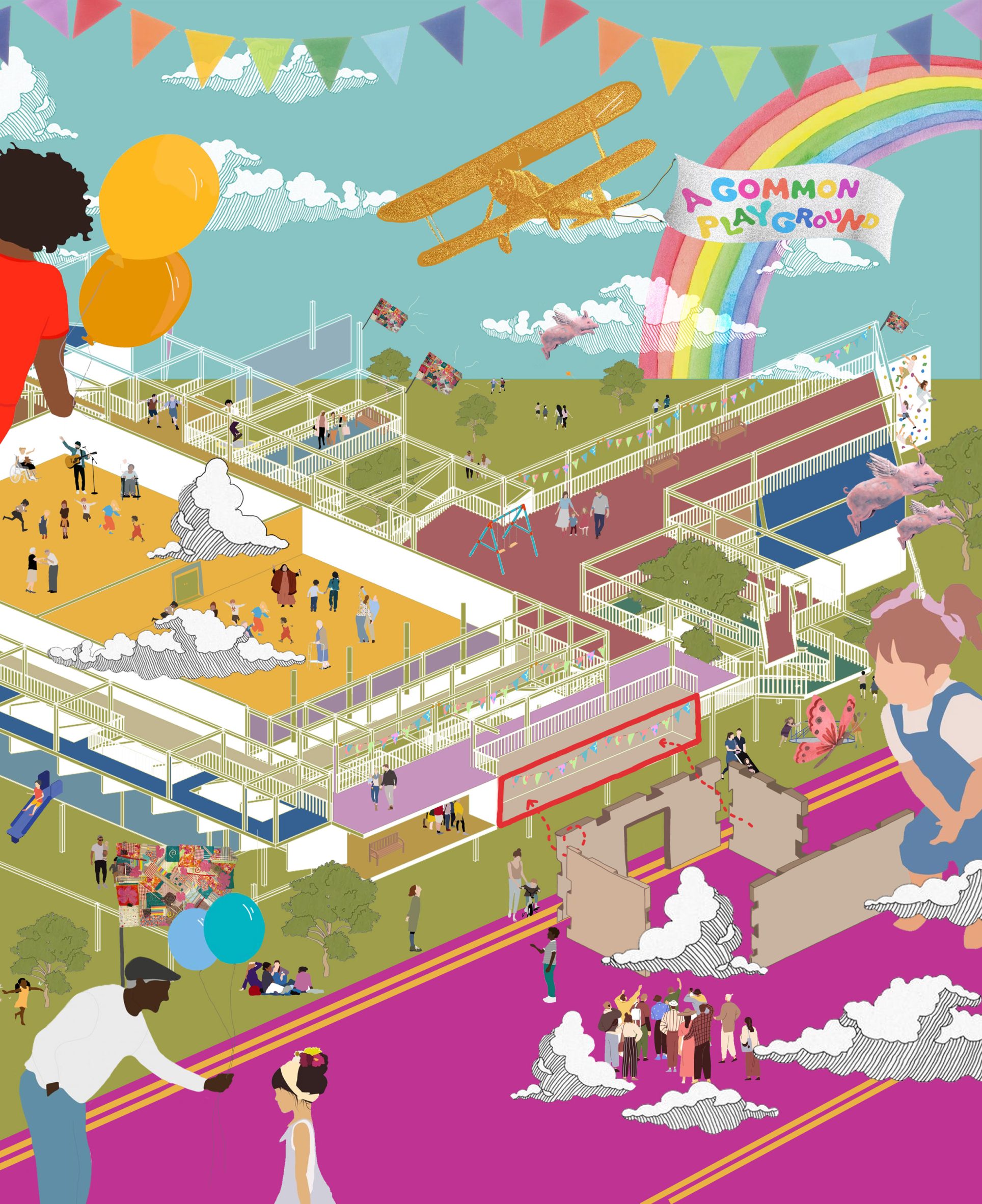
A Common Playground by Isabel Beal
“Within architecture begins with difference: embracing design for different people, through different methodologies, and toward different social ambitions.
“This year’s brief adapted Greater Manchester’s Live Well Agenda, proposing an intervention for a healthier, happier community in Moston, Northeast Manchester, by 2030.
“A Common Playground is both a Live Well Centre and a critique of wellbeing as an expression of urban policy.
“The utopian megastructure radically rethinks ‘the community centre’, uniquely positioning play as a fantastical, unifying force against the rising racism of the far right in the UK, bridging connections between even the most unlikely individuals.”
Student: Isabel Beal
Course: BA(Hons) Architecture Year 3 – Architecture Atelier
Tutors: Sam Holden, Curtis Martyn and David Johnson
![The Univer[city] of Aggre[gates] by Emin Huseynbayov](https://static.dezeen.com/uploads/2026/06/manchester-school-of-art-dezeen-schoolshows_dezeen_2364_col_4.jpg)
The Univer[city] of Aggre[gates] by Emin Huseynbayov
“The [CPU]Ai Atelier speculates on the university campus as a post-normal urban system, using computation, systems thinking and architectural intelligence to respond to social, technological and environmental change.
“The brief asks architecture to move beyond static form-making and engage with complexity, emergence and adaptation as tools for imagining future forms of learning, living and urban life.
“The Univer[city] of Aggre[gates] proposes a dystopian student accommodation megastructure responding to rising rents and the erosion of digital and bodily privacy.
“Using Weaire–Phelan aggregation, Metabolist plug-in logic and a 500-metre steel-and-concrete superstructure, the project imagines free housing exchanged for bionic experimentation, turning affordability, consent and transhumanism into one provocative architectural system for Manchester’s future university city.”
Student: Emin Huseynbayov
Course: BA(Hons) Architecture Year 3 – [CPU]ai Atelier
Tutors: Rob Hyde and Dan Newport
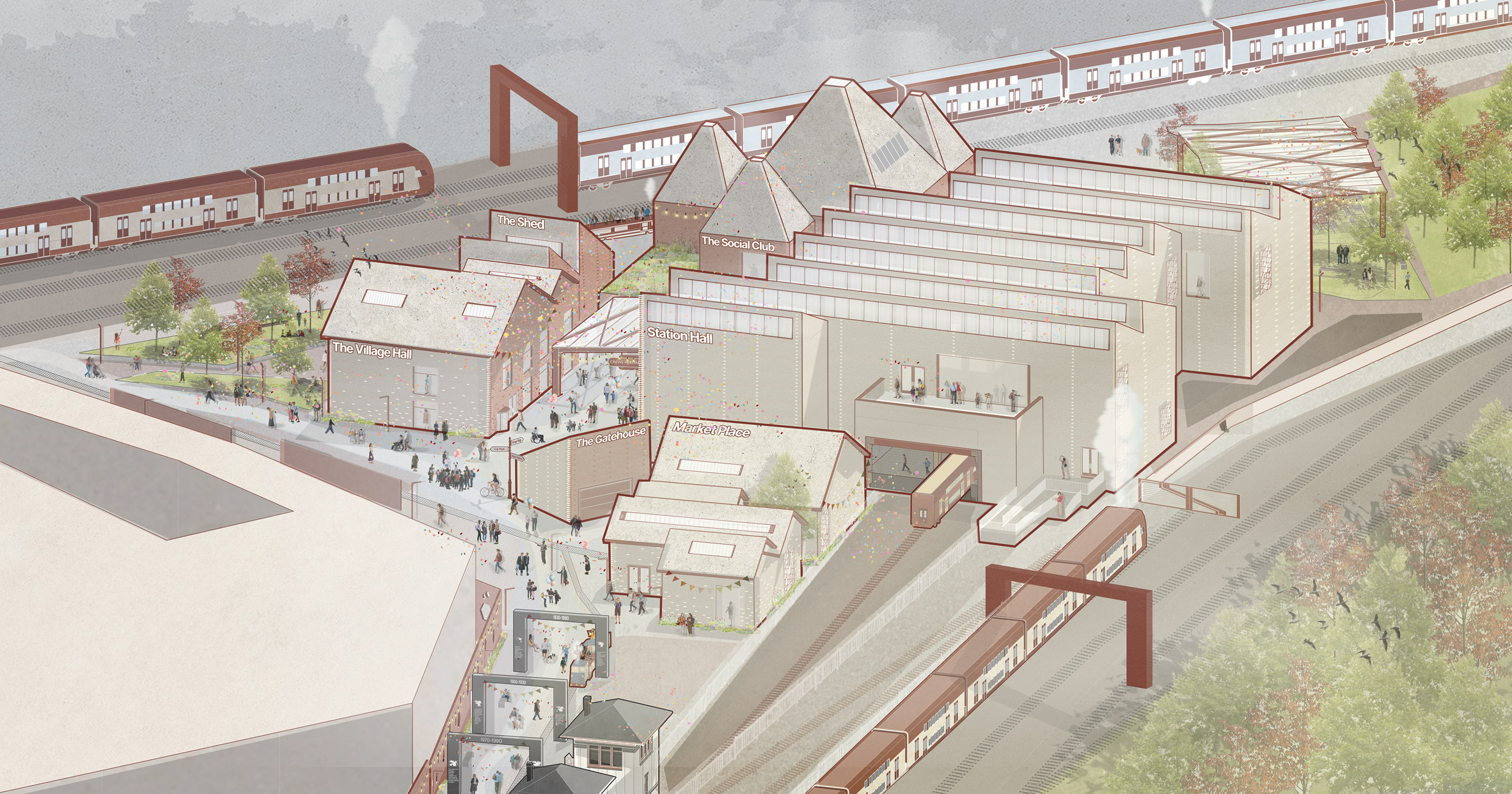
Crewe Heritage Centre, A Town for the People by Holly Froggart
“The Continuity atelier is interested in the cultural heritage of place. The brief focused on reimagining the existing Crewe Heritage Centre and surrounding public realm for 60,000 visitors.
“Located within a complex site between railway lines, the Heritage Centre stood disconnected from the city.
“A town for the people – captures Crewe’s ambition, reframing the site as a landmark within a city of urban artefacts.
“Rooted in townscape theory, each structure responds to its civic or industrial programme, where form is derived from Crewe’s historical morphology, rooted in principles of urban preservation.
“Through reversible architecture, and celebrating the art of craft and making, the Crewe heritage centre constantly evolves to redefine what heritage means to Crewe.”
Student: Holly Froggart
Course: BA(Hons) Architecture Year 3 – Infrastructure Space Atelier
Tutors: Johnathan Djabarouti, Mike Daniels, Neil Stevenson, Alberto Velazquez Yebenes
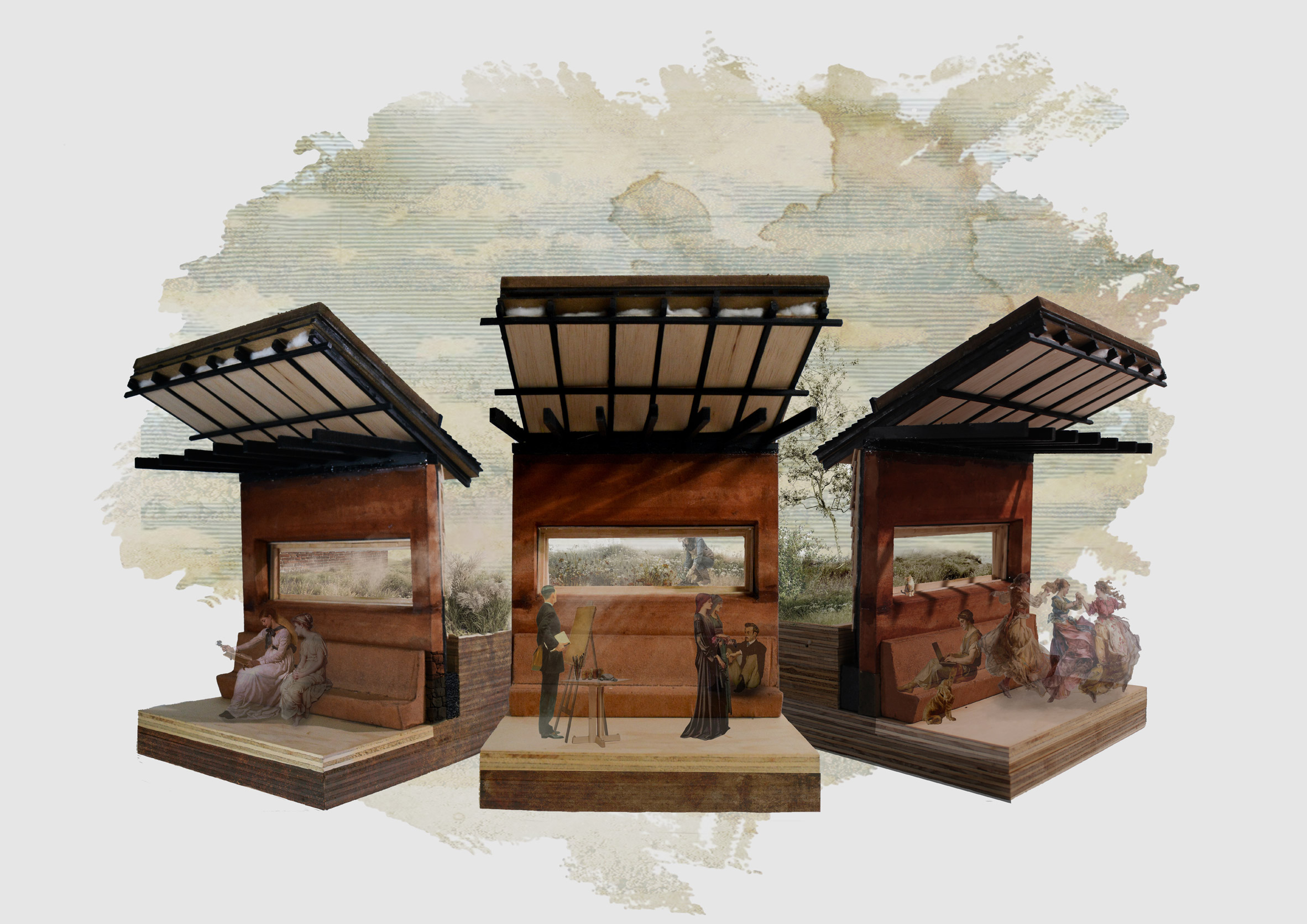
Room to Loiter by Catalina Cheptene
“Flux Atelier explores architecture through the lens of temporality, considering the built environment as a condition of continual transformation rather than permanence, and using situated practices within the evolving context of Mayfield, Manchester.
“Room to Loiter is a response to Manchester’s changing skyline, countering threatening skyscrapers to be developed in Mayfield, by descending into the Medlock Valley.
“With Mayfield Park sitting at the area’s core, this scheme fights commercialisation, establishing a community and nature-first identity inspired by walking as an activist practice.
“The project’s uniqueness lies in its radical design: using site-sourced rammed earth from Medlock Valley, it curates a sequence of sensorial moment-spaces alongside a descending ramp to the river, including a foraging-based pigment workshop.
“By functioning as a vertical threshold, the design brilliantly shifts eye levels, forcing us to see the world from entirely different perspectives, both literally and metaphorically.”
Student: Catalina Cheptene
Course: BA(Hons) Architecture Year 3 – Flux Atelier
Tutors: Lindsay Bush, Jo Hudson and Mike Burnell
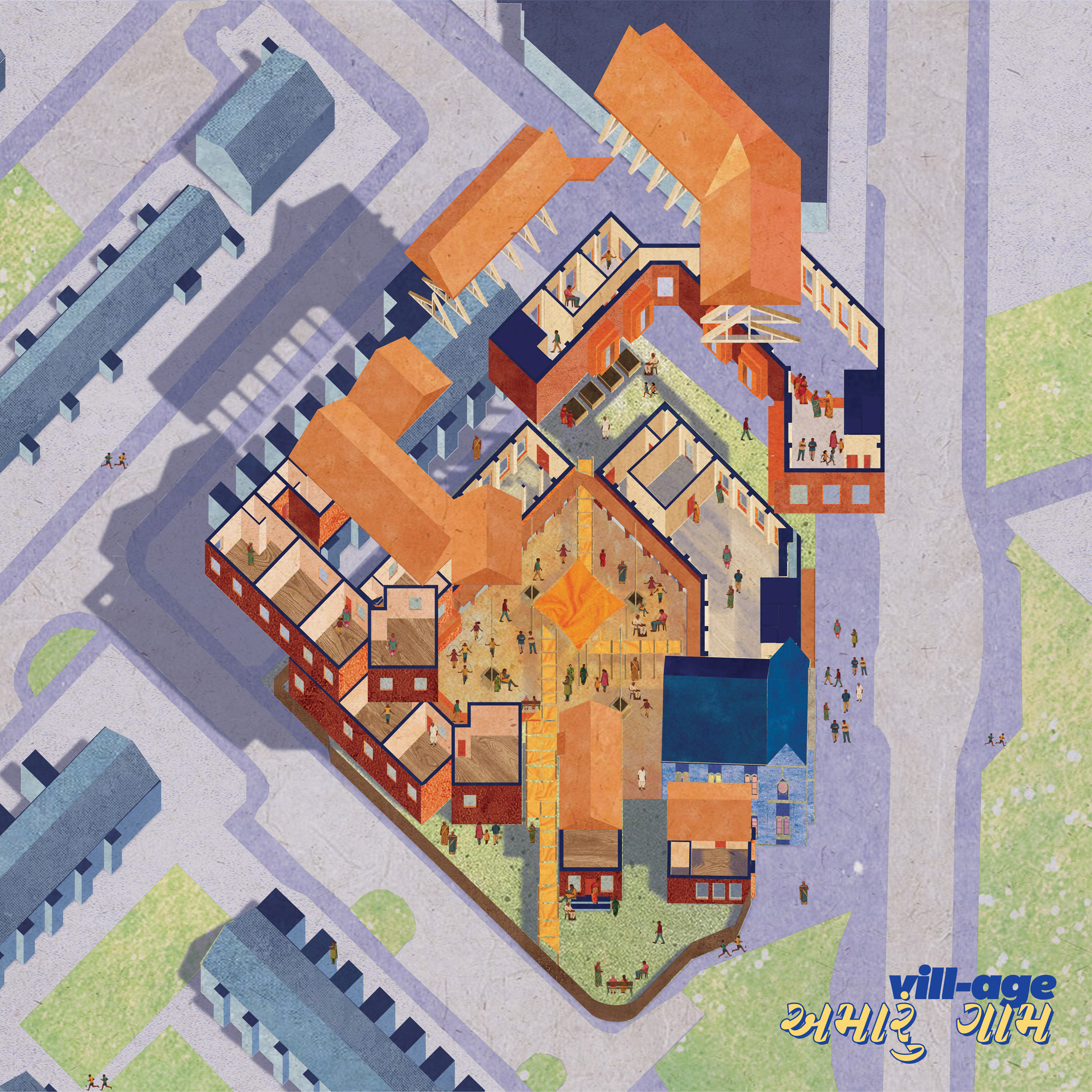
Vill-age: From Kitchen to Community by Anish Shah
“The Praxis atelier constructs its methodologies via a decolonial, intersectional, feminist lens. Our brief focused on investigating and proposing architecture that dismantles systemic barriers through care, providing equitable access to refuge for all.
“‘Vill-age’ is grounded in two fundamental questions – ‘who am I?’ and ‘who are we?’, discussing the necessity of celebrating identities and individual stories to strengthen communities. It realises the acts of the everyday as pivotal tools to reach inclusive spatialities.
“Through the development of an Anglo-Indian vernacular, and thorough exploration of personal histories and feminist texts, the scheme cultivates the notion of social dining as a reflection of cultural commons that slows and connects people, as well as co-housing that provides community to those aged over 65, of a South-Asian background.”
Student: Anish Shah
Course: BA(Hons) Architecture Year 3 – Praxis Atelier
Tutors: Azreen Azlan, Victoria Adegoke and Lorenza Casini
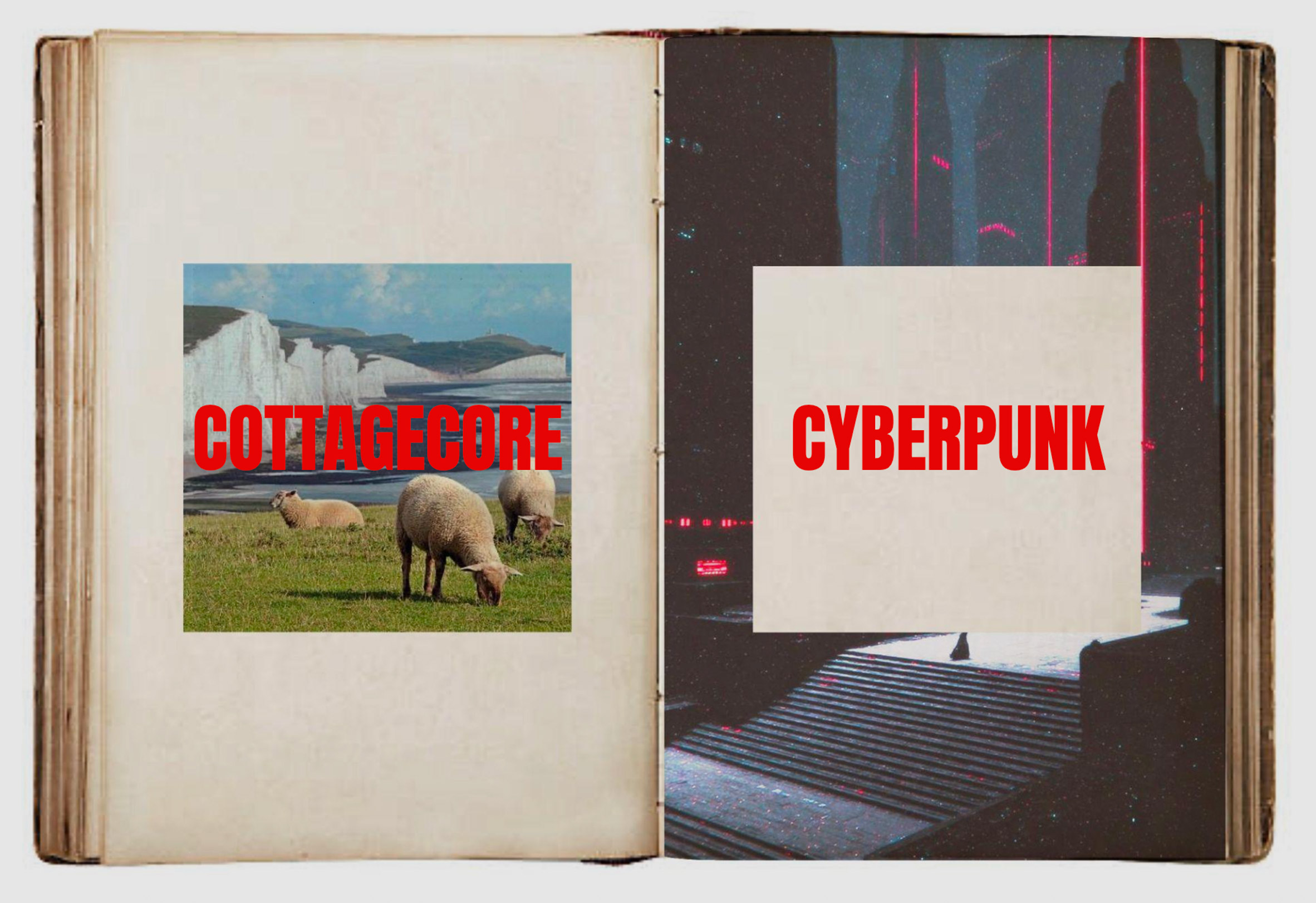
Aesthetic Escapism After the Collapse of Time by Ece Karagöz
“Developed within the ‘Architecture, Industry and Automation’ elective of Humanities 3 module, this paper repositions architecture beyond the physical city to examine how contemporary culture constructs alternative habitats of time under late capitalism.
“Through a comparative analysis of cottagecore and cyberpunk, the project argues that escapism no longer operates through utopian spaces, but through carefully designed temporal environments: one simulating slowness through pastoral interiors, domestic rituals and algorithmically curated villages, the other accelerating perception through dense cybercities, immersive interfaces and overstimulated digital worlds.
“Rather than existing as oppositional aesthetics, both expose the abstraction of time as a primary mechanism of escape.
“Cottagecore commodifies care, repetition and domestic labour as classed performances of temporal abundance, while cyberpunk aestheticises disembodiment and
optimisation, recasting exhaustion as immersion.
“Ultimately, the project argues that contemporary refuge no longer interrupts regimes of expansion, but has itself become structurally absorbed into the systems that manufacture fatigue.”
Student: Ece Karagöz
Course: BA(Hons) Architecture Year 3 – Humanities
Tutors: Stephen Walker, Kim Förster, Alan Lewis, Ewan Harrison and Leandro Minuchin
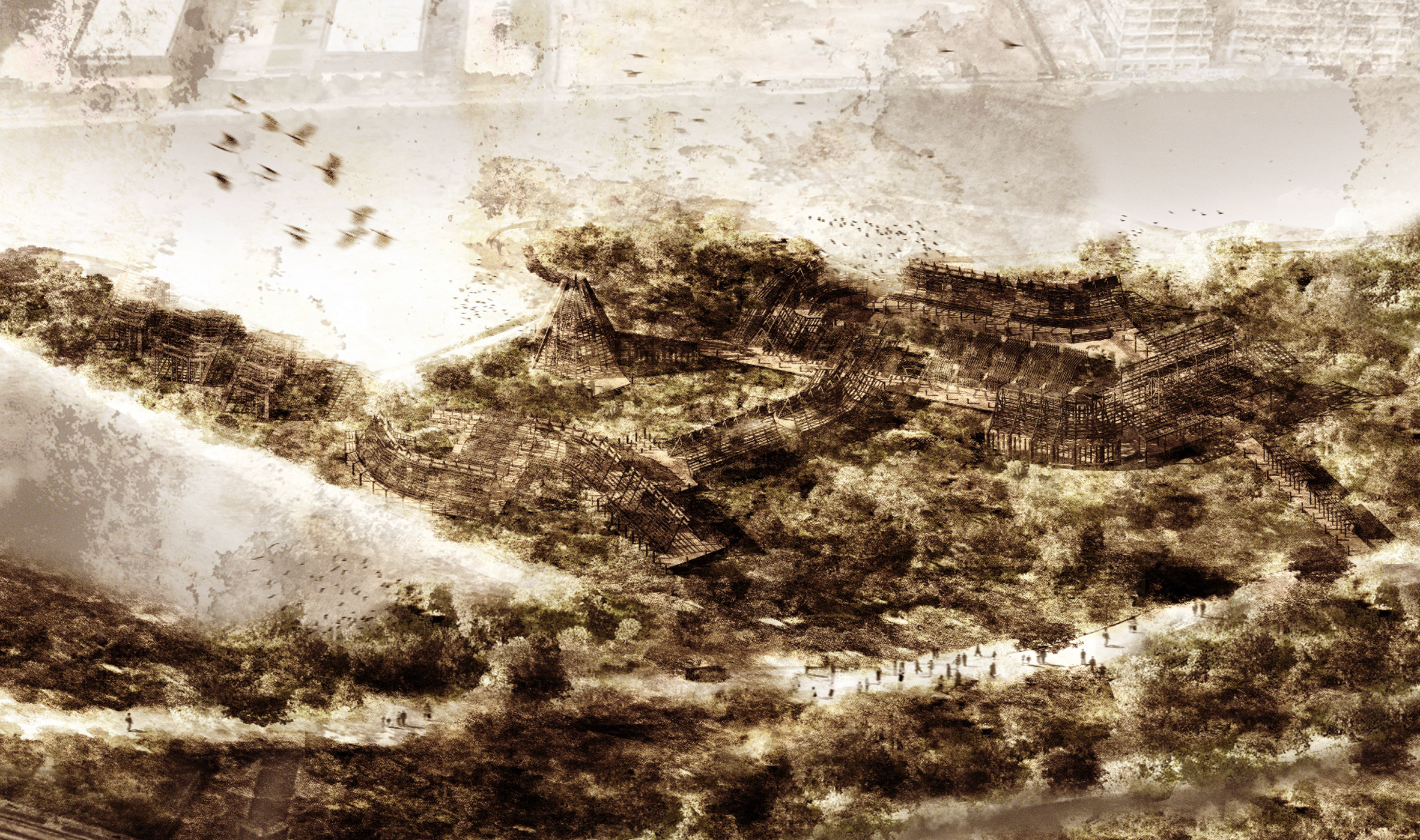
Museum of Decay by Eva Lippett
“The SKN atelier embodies a post-humanist philosophy, challenging conventional architectural ideals of permanence and human dominance amidst the ongoing biodiversity crisis.
“Rather than resisting time, the project redefines the museum by celebrating deterioration, tethering preservation instead to the slow grace of natural succession.
“As a columbarium, the Museum of Decay reimagines death not as finality, but as a chance for transformation, connection and commemoration.
“Mourning is woven into the landscape through temporary, biodegradable memorials embedded with seeds, with their gradual erosion transforming personal grief into ecological renewal, preserving the memory of those honoured through the germination of new life.
“As human presence slowly recedes, built form surrenders agency to nature, the site itself becomes an artefact of former occupation, and the structure now stands as an immovable protest of natural reclamation.”
Student: Eva Lippett
Course: BA(Hons) Architecture Year 3 – Some Kind of Nature Atelier
Tutors: Guillermo Sanchez Sotes and Dan Renoso-Urmston
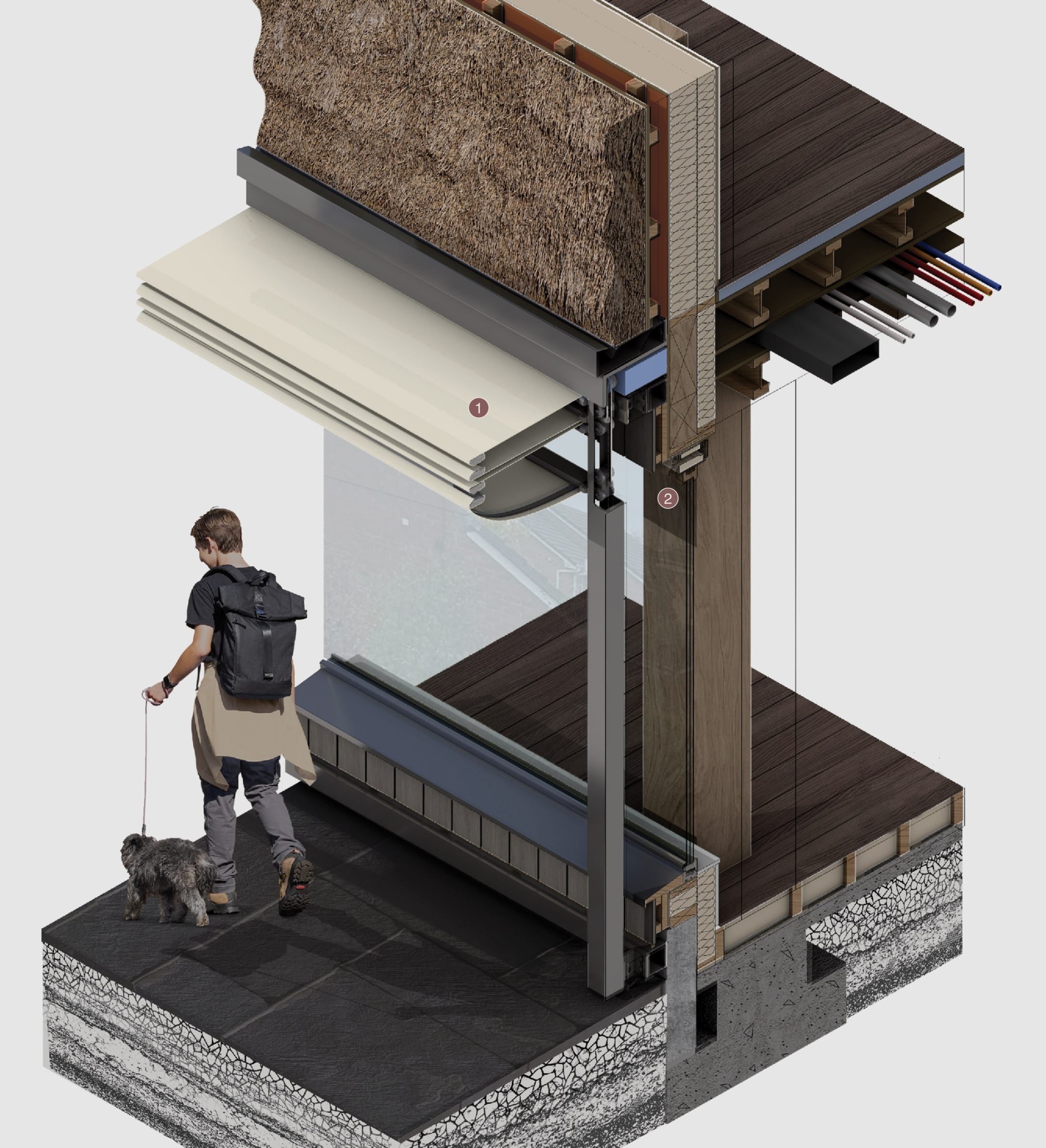
Technological Integration Detail by Zixuan Zhang
“The BA3 Technologies module explored how a focused technological solution can translate strategy into spatial experience through detailed architectural resolution.
“Developed within the BA3 Technologies module and integrated with the studio project, Zixuan Zhang’s project explores how an architectural facade system can respond to the conflicting environmental demands within a workshop space.
“Reflecting the ethos of the architecture atelier, the design embraces difference rather than uniformity.
“A kinetic foldable facade adapts between two spatial conditions: enclosed and filtered for digital workshops requiring glare control and privacy, and open and breathable for art and craft activities that demand daylight and ventilation.
“Instead of remaining static, the building continuously transforms in response to the programme, climate, and occupation, turning environmental performance into an active spatial experience.”
Student: Zixuan Zhang
Course: BA(Hons) Architecture Year 3 – Technologies
Tutors: Gareth Puttock and Siobhan Barry
![[after]LIFE by Emir Hasanagovski](https://static.dezeen.com/uploads/2026/06/manchester-school-of-art-dezeen-schoolshows_dezeen_2364_col_2.jpg)
[after]LIFE by Emir Hasanagovski
“Within the Infrastructure Space Atelier, future territorial conditions are explored through speculation grounded in its ‘data-mapping’ ethos, treating it as inseparable from the infrastructure and flows that produce it.
“This year, BA3 students were tasked with [re]interpreting the concept of monumentality within the future St Cuthbert’s Garden Village, embedding it within a future spatial condition.
“[after]Life examines pre and post-mortem processes and their spatial and metaphysical interactions as parts of a broader system.
“The project monumentalises an alternate burial method, utilising human composting as an instrument for questioning ecological and societal norms, creating a speculative system of death infrastructure.”
Student: Emir Hasanagovski
Course: BA(Hons) Architecture Year 3 – Infrastructure Space Atelier
Tutors: Dragana Opačić Wilkinson, Paul Robinson and Richard Morton
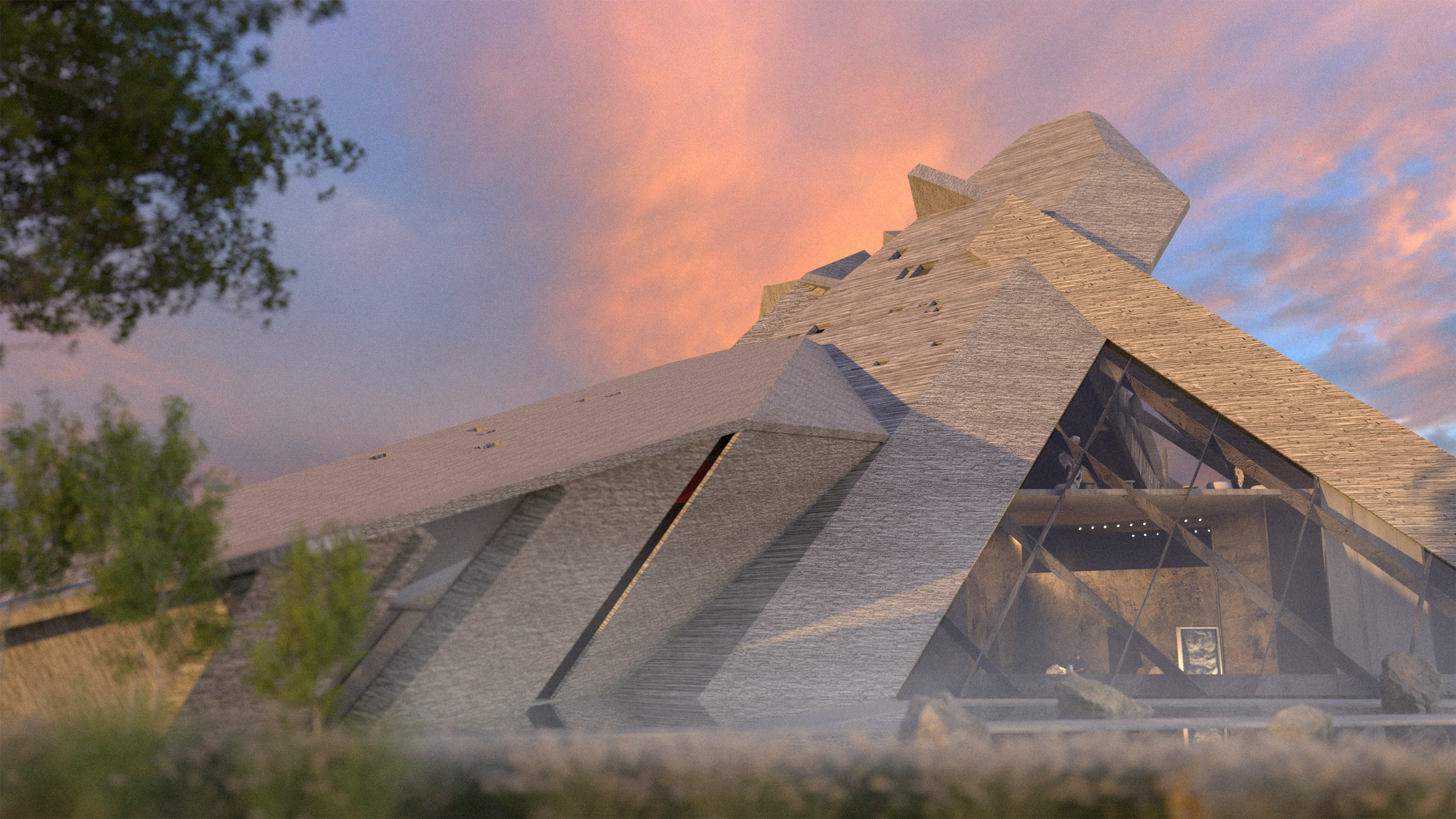
The Shards: A Natural History Museum in Cumbria by Benson Tsai
“St. Cuthbert’s Garden Village in northern Cumbria confronts a challenge endemic to the emerging development: the absence of a shared identity.
“Its communities are delicate and vulnerable to the disorientation that disconnection breeds. What is needed is a monument as an infrastructure that is resilient and rooted in history for people to erect a new collective sense of belonging.
“The Shards propose a natural history museum at the convergence of three communities within The Village Centre, functioning simultaneously as a spatial, conceptual and infrastructural anchor for a regenerative future.
“The converging facades read as tectonic forces made permanent. Angular shards of the earth meeting at the central point, uniting the communities.
“Rooted in Cumbria’s volcanic heritage, the museum teaches the past identities while acting as the driving force for the emergence of the new identities to come.
“Past monuments may have lost their original owners and users. But their presence and identity still stand strongly and firmly to this day.
“The shards aim to remain firmly in place beyond human existence, rooting the identities of the present deeper into the geology and memory of place.”
Student: Benson Tsai
Course: BA(Hons) Architecture Year 3 – Infrastructure Space Atelier
Tutors: Dragana Opacic Wilkinson, Paul Robinson and Richard Morton
Partnership content
This school show is a partnership between Dezeen and Manchester School of Architecture. Find out more about Dezeen partnership content here.
The post Museum with shard-like facade among projects from the Manchester School of Architecture appeared first on Dezeen.