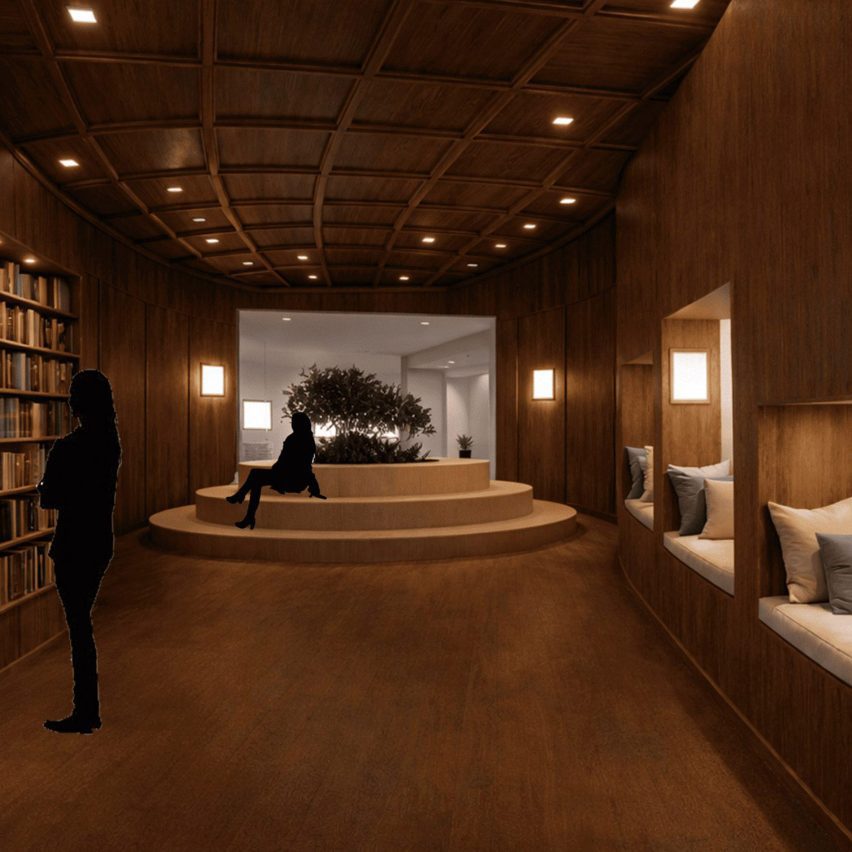
Dezeen School Shows: a tactile space informed by a comma as a “moment of pause” is among the student projects from Virginia Commonwealth University School of the Arts in Qatar.
Also featured is a wellness centre designed for individuals navigating obsessive-compulsive disorder and an interactive card game that introduces players to the social tradition and etiquette of the Qatari Majlis.
Virginia Commonwealth University School of the Arts in Qatar
Institution: Virginia Commonwealth University School of the Arts in Qatar
School: School of the Arts
Courses: (BA) Art History, BFA Graphic Design, BFA Interior Design and BFA in Painting and Printmaking
Tutors: faculties of Art History, Graphic Design, Interior Design, Painting and Printmaking
School statement:
“This year’s online exhibition presents research-driven work from the class of 2026 that defines contemporary practice and critical inquiry.
“What is an astrolabe? Can karak tea reveal a deeper tale of cultural connection? How has digital media affected how we remember?
“These were among the questions explored by senior students at Virginia Commonwealth University School of the Arts in Qatar and presented online for the 2026 graduation showcase, marking the culmination of their journey from foundational coursework to creative and critical execution.
“The exhibition is now live online and features work by students from five programmes at VCUarts Qatar: Art History, Graphic Design, Interior Design, Painting and Printmaking and Master of Fine Arts in Design.
“Collectively, the projects reflect how the students combined technical skills, thoughtful introspection and curiosity to address timely themes through research, art and design.
“The 2026 VCUarts graduation showcase featuring the work of 67 VCUarts Qatar graduates is now available for viewing at portfolio.qatar.vcu.edu.”

Routes of Karak by Nourhane Tarroun
“Karak tea is widely consumed across Qatar and is typically served in small takeaway cups from neighbourhood cafeterias and roadside tea shops. The drink moves through everyday routines, appearing during commutes, work breaks and late-night gatherings across the city.
“The drink is made from ingredients like tea, sugar, cardamom and cinnamon that reached the Gulf through Indian Ocean trade routes. These materials, along with chai-making practices brought by South Asian migrants in the twentieth century, were adapted to local conditions and tastes.
“Through this process, karak became embedded in daily life while retaining traces of its transregional origins. Through its ingredients and circulation, karak reflects connections that extend beyond the gulf.
“The drink carries histories of movement that continue to structure everyday life. Karak shows that what is understood as local is shaped by ongoing transnational exchange.”
Student: Nourhane Tarroun
Course: Bachelor of Arts in Art History
Email: tarrounn[at]vcu.edu

The Dress I Knew First by Haya Ali AlThani
“The Thawb Al Nashl is a square-cut ceremonial dress worn by Qatari women at henna nights, Ramadan and National Day celebrations. The garment marks occasions when feminine identity and collective belonging are made publicly visible.
“Its defining feature is a zari embroidery panel – metallic thread wound around silk – running from the neckline to hem. Zari embroidery was developed under Mughal India and reached the Gulf through maritime trade networks connecting Gujarat to Gulf ports.
“By the 1940s, Bahrain had established itself as the regional production centre, where artisans worked imported thread materials into finished thawbs distributed across the Gulf Coast to Qatar.
“The Thawb Al Nashl accumulates cultural significance through its continued use at celebratory occasions, which is a practice rooted in the same Gulf trade networks that first brought the garment and its embroidery tradition to Qatar, reflecting a shared cultural practice sustained through commerce and exchange.”
Student: Haya Ali AlThani
Course: Bachelor of Arts in Art History
Email: althaniha6[at]vcu.edu

A Call Across the City (Mosque loudspeaker) by Noora Hassan Alderham
“The mosque loudspeaker shows how everyday life in Qatar is shaped through shared sound. Although the call to prayer is heard across many Muslim societies, in Qatar it takes on a distinct presence within the country’s urban and social fabric. As it moves across neighbourhoods and into homes, it creates a daily auditory rhythm that connects private life with public space.
“In this sense, the loudspeaker is not only a religious device, but part of how Qatar is collectively experienced and remembered. This sound operates at both local and transnational levels by linking Qatar to the wider Islamic world, while remaining embedded in daily life. Its repetition becomes recognisable and carries emotional weight.
“Through this shared sensory experience, belonging is formed not only through visible symbols, but also through what is heard. Within the exhibition, the mosque loudspeaker reflects the idea that home is built through ordinary, repeated encounters to show how memory and belonging are shaped through sound as much as sight.”
Student: Noora Hassan Alderham
Course: Bachelor of Arts in Art History
Email: alderhamnh[at]vcu.edu

Lakas: Echoes of Indios by Julianne Eden Pagulayan
“To remember our past, we must play through it.
“This project brings forgotten history and oral folklore to a new generation through the digital platforms they use every day.
“Lakas: Echoes of Indio is a 2D side-scrolling platformer RPG featuring combat and survival mechanics, where players experience Philippine folklore during the colonial era through the eyes of Lakas, a young Bagobo survivor who escaped slavery.
“Created for Filipino kids in Qatar, this work helps them to appreciate and own their roots. By turning traditional stories into an interactive game, I aim to share Filipino culture with the world. This ensures our indigenous heritage gains recognition within the global gaming industry, while connecting a modern generation to their history.
“Play the game: https://bytheluck.itch.io/“
Student: Julianne Eden Pagulayan
Course: Bachelor of Fine Arts in Graphic Design
Email: pagulayanjv[at]vcu.edu

MENA by Mariam Al Hashemi
“I did not begin with watches as an object of interest, but with the person who taught me how to see them: my dad. This project is a collection of watch dials inspired by personal stories from the Kuwaiti invasion.
“Each experience is translated into a dial composition, where form, material and mechanism are used to communicate a story. Different mechanisms are used across the collection to reflect each experience, while certain elements remain consistent to connect the collection as one. The shape of each dial also carries the story, giving each piece its own presence while staying part of the same system.
“The outcome is three watch dials (39 mm), developed as physical prototypes and presented through a catalog that reveals the story behind each piece.”
Student: Mariam Al Hashemi
Course: Bachelor of Fine Arts in Graphic Design
Email: alhashemim2[at]vcu.edu

Qatari Majlis Etiquette by Fatima AlMuhannadi
“The Qatari Majlis is more than a place to gather. It is a social tradition shaped by hospitality, conversation and shared customs. Because its etiquette is often learned through observation, it can feel unclear to newcomers, expatriates and even younger Qataris.
“This project reinterprets Majlis etiquette as an illustrated, bilingual card game that invites players into different Majlis scenarios. Players make decisions and test their understanding of respectful behaviour. Rather than memorising rules, they recognise situations and respond in the moment, similar to how Majlis etiquette is experienced in real life.
“Designed as both an educational tool and an engaging experience, the project encourages learning through curiosity and thoughtful choice while celebrating the warmth and spirit of the Majlis.”
Student: Fatima AlMuhannadi
Course: Bachelor of Fine Arts in Graphic Design
Email: almuhannadfk[at]vcu.edu

Threads by Yara Alazab
“Threads is a culturally sensitive wellness and outpatient centre in Doha, designed for individuals navigating obsessive-compulsive disorder (OCD) – specifically contamination OCD and checking OCD – while bringing together families and the wider community through therapeutic, educational and shared spaces.
“The centre includes ERP therapy rooms, workshops and communal spaces that support both treatment and learning. These spaces allow users to engage gradually, to move at their own pace and to feel more in control of their experience.
“Through order, controlled progression and clear spatial organisation, the design reduces uncertainty and supports users in managing compulsive behaviours while fostering understanding and interaction.
“By shaping how people think, feel and act, Threads positions interior design as an active tool for therapeutic support.”
Student: Yara Alazab
Course: Bachelor of Fine Arts in Interior Design
Email: alazabyt[at]vcu.edu

Tethered From Afar by Fatima Al-Haddad
“Tethered from Afar is a community-focused interior design project that addresses the emotional and social challenges faced by expatriate mothers living in Qatar. Many experience isolation, loss of support systems and disconnection from their cultural identity due to long-term separation from their families.
“The project proposes a restorative cultural environment that fosters belonging through shared activities, workshops and communal spaces. Inspired by the concept of embroidery, the design translates ideas of connection, layering and interwoven relationships into spatial form.
“Located in Marsa Katara, the project integrates cultural exchange with a calming waterfront setting. Through its spatial organisation and programme, it aims to support emotional wellbeing while celebrating cultural identity and community.”
Student: Fatima Al-Haddad
Course: Bachelor of Fine Arts in Interior Design
Email: alhaddadfi[at]vcu.edu

Sparklers by Tarishah Fadilah
“This project presents a series of illustrations and simple frame-by-frame animations of sparks – inspired by sparklers – to symbolise feelings such as anxiety, dread and numbness.
“Like sparklers, these emotions appear as constant, tiny sparks that may seem insignificant on their own, but they can build up and become deeply uncomfortable.
“The sparklers also represent the contrast between danger and joy, especially in childhood. In Indonesia, many children grow up and find happiness playing with sparklers and fireworks, despite the risks. That same contradiction is reflected here: even when these sparks feel dangerous, there’s still joy in those moments.
“By contrast, fireworks are grand, loud and impossible to ignore. These sparks remain subtle, persistent and intimate, reflecting the quiet intensity of internal turmoil.”
Student: Tarishah Fadilah
Course: Bachelor of Fine Arts in Painting and Printmaking
Email: fadilahtr[at]vcu.edu

Spirits by Shaymaa Al-khauri
“This project explores the essence of presence and what it means to exist within a fleeting moment.
“Through ink on paper, expressive brushstrokes become a visual language that reflects the turbulence of human experience and the continual reshaping of the self. These marks embody resilience, capturing the spirit’s ability to endure, adapt and move forward despite adversity.
“Accompanying the visual work, a poem narrates the journey of intangible spirits, offering a metaphorical reflection on emotional and existential transformation. This narrative extends into a short film, which constructs an imagined realm where these spirits meet and reside, dissolving the boundaries between inner and outer worlds.”
Student: Shaymaa Al-khauri
Course: Bachelor of Fine Arts in Painting and Printmaking
Email: alkhauris[at]vcu.edu

In Doha’s Ether (2026) by Latifa Alsulaiti
“An ongoing photography project that began by utilising the absence of a studio as a method of practice, evolving into an exploration of liminal areas in Doha.”
Student: Latifa Alsulaiti
Course: Bachelor of Fine Arts in Painting and Printmaking
Email: alsulaitilt[at]vcu.edu

Voices of Freedom by Asma Mlisan
“The Syrian revolution chants of 2011 are collective vocal expressions of resistance and solidarity, serving as living cultural sound records that reflect the resilience of communities using voice as a tool for visibility.
“As a Syrian designer living in the diaspora, this project is driven by the urgent need to address the lack of institutional, cultural and historical preservation within Syria, where displacement and a lack of documentation threaten the survival of these oral traditions.
“This thesis archives these chants by transforming fragile oral history into a tangible musical album, comprising a CD filled with the chants, a poster and a lyrics book that showcases graphical elements extracted from Syrian tiles and pre-documented photographs.
“By utilising design as a medium for archiving and storytelling, this work aims to safeguard intangible cultural memory and to ensure that the echoes of collective resistance are preserved for future generations.”
Student: Asma Mlisan
Course: Bachelor of Fine Arts in Graphic Design
Email: mlisanao[at]vcu.edu

Comma by Hajer Alsayed
“Comma is a place designed for introverted women in the Gulf, responding to overstimulation and social fatigue in public environments. It rethinks visibility by allowing users to control how they engage, withdraw and exist within a shared space.
“Inspired by the comma as a moment of pause rather than an end, the project creates layered thresholds, soft transitions and sensory-controlled environments. Through tactile materials, muted contrasts and fluid circulation, the space supports introversion rather than attempting to change it.
“Comma offers a way to remain present in a public space, while having the option to pause, recharge and return.”
Student: Hajer Alsayed
Course: Bachelor of Fine Arts in Interior Design
Email: alsayedha2[at]vcu.edu
Partnership content
This school show is a partnership between Dezeen and Virginia Commonwealth University School of the Arts in Qatar. Find out more about Dezeen partnership content here.
The post Introvert social fatigue among concepts tackled by VCUarts Qatar appeared first on Dezeen.